Home Blog Page 17

3 Ayurveda Home Remedies for Controlling Asthma

0

If you suffer from asthma, you’ll know the pain and stress when an attack happens. Even when there isn’t an attack, and you just start to feel tight-chested and short of breath, it can leave you unable to do anything you were going to do that day.

At best, it’s frustrating. It doesn’t matter what you’re allergic to or what sets it off, all that you start to focus on is how to get back to normal. Fortunately, Ayurveda medicine has an answer that might interest you.

Today, we’re going to explore three key Ayurveda treatments that can get you back on your feet and doing what you do best.

Ginger Tea

Ginger tea is famous through Ayurveda teachings for its medicinal properties, and the same can be said when it comes to asthma. You need to take a cup of hot water and add a ginger tea bag. Alternatively, for a more natural and possibly effective medicine, grate some ginger root into your cup.

Then, take two garlic cloves, crush them up and drop them into your tea as well. Now, leave the brew to simmer for a couple of minutes, take out your bag and sieve out the garlic (and the grated ginger) and slowly sip it while relaxing in a chair.

You should start to feel better almost immediately. In Ayurveda terms, this works because the formula helps to alleviate the Kapha accumulation in your airways, the cause of your asthma attack or symptoms.

Turmeric Powder

Turmeric powder is renowned for its beneficial properties throughout Ayurveda practices, and here, it is just as effective. If taken twice a day, this can help you to build up a long-term resistance against asthma symptoms as well as reducing the frequency of the attacks.

All you need to do is to freshly grate some ginger (around a teaspoon) and boil it. Then, add it to a glass of milk. Mix it thoroughly while adding around ½ a teaspoon of turmeric powder. Then drink the milk in your own time.

Cinnamon

Cinnamon is one of nature’s greatest assets. It’s so beneficial for people to consume it because of its natural healing and Ayurveda properties. With this formula, it’s also recommended that you administer it twice a day, reducing symptoms and resulting less frequent attacks.

Similar methods to the above, boil up a cup of water and add one teaspoon of cinnamon and also around ¼ of a teaspoon of trikatu if you have it available. Mix them both into the water thoroughly and let it sit for ten minutes or so. Then, add a teaspoon of honey and drink!

Try giving these Ayurveda medicines a try and see what they can do for you. It’s highly recommended that you try these alongside your medication and don’t stop taking it unless your doctor says otherwise. If it works for, you’ll be able to start living your days again without asthma holding you back!

3 Reasons to do Yoga in the Morning

0

Me, and a tonne of other bloggers on the internet are always stating how things like meditation and yoga should be completed in the morning as early as possible. I personally recommend doing it as the first thing you do when you get up and out of bed.

However, to many of us, getting up a 6 am and jumping straight into a form of exercise doesn’t really sound too appealing. However, I believe yoga is one of the best things you can do for your body and it’s beneficial any time of the day.

But, are there are benefits to actually doing it in the mornings? Today, we’ll explore three key reasons why yoga should be your preferred way to start your day.

Improving Your Diet

I’m going to start with a point that not many people look at. If you do yoga as the first you do in the morning, you’ll become aware of whether or not your diet was what your body needed the day before. For example, if you get up, jump onto your yoga mat, you may start to feel bloated, gassy and might not feel like you have a lot of energy.

As we sleep, our bodies are still very much at work, digesting food and refuelling our muscles. However, if you feel like the above, the chances are that your diet wasn’t very good yesterday. However, if you get onto your yoga mat and you feel alive and energised, you’ve served your body well. This knowledge can help massively when it comes to eating a proper, healthy diet.

Set the Pace for the Day Ahead

Starting yoga in the morning mean you’re setting the time aside, whether it’s ten minutes or an hour, to focus on your breathing. Have you ever had the feeling where you’ve realised your late for work and you’ve had to rush out without really stopping? This feeling usually lasts the whole day and it’s not a great way to live. After all, it’s full of stress and anxiety.

However, by getting up and completing a yoga session, you’re setting your breathing for the rest of the day. This helps you stay cool, calm and collected, no matter what life has to throw at you.

Promotes a Healthy Day Ahead

The chances are that when you’ve finished your yoga routine in the morning, you’re going to be feeling pretty good. This means you’ll be feeling happy, energized and, most importantly, healthy. What a great way to start your day and since you’re feeling this alive, you’re going to want to keep it going.

This means when you start carrying out your jobs and eating food, you’ll be automatically making healthy decisions. You’ll be in the frame of mind to put your health first. This is one of the most positive ways you can feel about yourself!

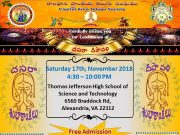
2017 DASARA DIWALI Celebrations by Capitol Area Telugu Society

0

Event: Dasara/Diwali Celebrations
When: October 07th 2017
Where: Gaithersburg High School
101 Education Blvd, Gaithersburg, MD 20877

Organized by: Capitol Area Telugu Society ( CATS )

**FREE EVENT**ALL ARE WELCOME

3 Benefits of a Body-Scan Meditation

0

Whether you’ve been reading a book, following an app or using online sessions, you may have noticed that some meditation sessions are titled ‘body scan’, or ‘full-body scan’. You may have even tried the body scan yourself.

In most cases, the sessions will start at the top of your head or the bottom of your feet and move upwards. You’ll pay attention to all of your muscles and body parts, putting each one into a state of relaxation. However, are there any benefits to these scans or are they simply another form of meditation. Let’s find out!

Enhance Your Focus & Concentration

During a full body scan, you’ll find that you’re constantly aware of your body. Through regular practice, this helps you to improve your level of concentration. A full body scan will typically last anywhere between ten minutes and an hour. The whole time you’ll be improving your focus skills by really focusing on the parts of your body and how they feel.

Becoming More Self-Aware

This is a common benefit of meditation but even more so when it comes to full body scans. If you’ve got a tightness in your body, such as your back or your legs, you may not be aware of it. This is because our days are normally very busy and it’s easy for us to be used to how it feels.

However, through a scan, you can become aware of these pains and aches. During the scan, you’ll be told to breathe into these parts of the body so you can relieve the stress. But, the stress doesn’t go, you’ll be more aware of this ache, enabling you to do something about it, so it doesn’t cause any long-term damage.

You may also complete a scan and realise your body felt great, which a positive boost to your self-esteem!

Becoming Present

Another common benefit of meditation but again, more so in body scans. A body scan massively helps you to become more present. Too much of our lives are spent analysing the past and worrying about the future. However, the past is gone, and the future doesn’t exist, all that matters is right now.

Yes, that’s right this very second. Are you making the most of it? Because that second has now gone forever and the one we’re in now is going!

See, if this sentence makes you worry that time is going too quickly, it doesn’t have to be that way. Instead, see this as a positive moment where every second will count.

Full body scans can help you achieve this state of present awareness which can echo throughout every corner of your life.

Ayurveda Hospital’s Revolutionary Maternity Unit

0

Residents in the capital city of Poojappura will now have revolutionary access to Ayurveda and allopathic treatments during their stay whilst giving birth to their children. The brand-new maternity room, with an included surgery theatre, has been opened at the Government Ayurveda College Hospital for Women and Children.

Opened earlier this month, this revolutionary and innovative move means the hospital is the first ever hospital in the state to cater for childbirth. Caesarian sections, commonly known as C-sections, can be performed here. The state-of-the-art facility can cater for up to four childbirths at the same time. Inside the delivery room, you’ll find the latest technologies including the addition of medical gas.

Recently, the hospital has come under scrutiny for its low delivery figures. Back in the 1990s, the hospital used to deliver an average of 500 children a year. This figure has dramatically dropped over the last two decades. In recent years, this delivery figure averages around 5 to 10 children a year. After extensive investigations, it was discovered that the labour room had undergone no development or upgrades since it opened. This area of the hospital was opened in 1955.

Poojappura District Medical Officer was reportedly made aware of this problem back in 2014. Since then, over 1.13Crore has been invested into the site in the form of work and improvements. This work has been carried out by HLL Lifecare Limited.

The hospital is one of the only hospitals in the world to offer both forms of medical treatment. The treatment offered depends solely on what the patient requests, giving them access to the treatment they require. This is important, especially for pregnant women, who are concerned with traditional practices of childbirth.

It’s renowned that modern day medicines that are commonly used in childbirth can affect the foetus in a variety of ways. If problems have been discovered, allopathic doctors can refer the patient to an Ayurveda doctor instead.

A Revolutionary Hospital

Currently, there is a full set of staff working in the unit, hoping to boost the numbers the hospital currently receives. There are leading specialists including gynaecologists, medical practitioners and a paediatrician. There are also six Ayurveda doctors on site.

In addition to this unit, patients also have access to specialist services. This includes infertility, disability development and special needs units. These services combined aim to give the public access to a greater and more diverse range of services that help to promote a better healthcare system in the local community.

Let us know what you think! Do you think Ayurveda doctors should be available in all hospitals across the state? Or do you think dedicated Ayurveda hospitals should be set up adjacent to allopathic hospitals? Let us know your thoughts in the comments below!

A Day of Disconnecting

0

We are constantly connected to our digital devices; it’s a given. As people, we are constantly connected to the Internet and therefore the rest of the world. Writing this, I’m sat in a café which is playing music through an online app as I’m connected the Wi-Fi connection with my smartphone next to me for answering emails. As a blogger, I’m probably more connected to the Internet on a daily basis than most people but being connected is a very interesting concept. On Friday 28th July 2017, I decided to try disconnecting for an entire day.

I put all my work on hold the day before, answered all of my essential emails and turned everything off. I have practised constant meditation and yoga for a month now and, through this blog, I constantly preach about the concepts and ideologies of being present and aware of what we are doing. So, in light of this, I decided to switch off for a day to become truly present. Browsing our social media feeds and constantly analysing our calendars keeps us from being present so I decided to test this theory.

Waking Up

When I awoke on Friday morning, I instantly got up, meditated and completed a 15-minute yoga session and instantly went for my smartphone, as I normally would, to check my emails. As I went to unlock my device and realised it was off, I remembered what I had set out to do! Just from habit, I had already forgotten what I had planned to do. So instead, I went down to breakfast and sat contemplating what to do for the day.

Usually, I would be getting ready to work or would take my morning tea to my office and make a start. Instead, I simply sat and enjoyed my breakfast looking out my kitchen window. I was already starting to feel the benefits of simply taking in what was around me. From here, I decided to go for a walk. I live in a very rural area so it’s easy for me to get lost in the great outdoors and I quickly found myself very far from civilisation.

Connect With Nature

The sky looked beautiful, the air felt pure but I still felt urges to access my phone. As a hobby, I love photography, and my smartphone has one of the leading cameras which helps me to practice. I walked past several photo opportunities but simply appreciated them for what they were without having to take a picture. Admittedly, it was a strange experience, but it was liberating, knowing I would be the only person to ever witness this exact event without having to share it on my feeds.

When I returned home, I phoned my other half on my landline phone for a quick catch up of her day before wondering how to spend my afternoon. I cooked a nutritious lunch, a pastime I usually rushed in light of getting back to work. I then sat in the garden and read all afternoon. Once it got to the evening, I invited my family over, and we sat and chatted for hours. It was very strange to see the rest of my family picking up and putting down their devices to answer messages or to check their feeds whereas I hadn’t touched mine once. I then read a bit more and went to bed. I would usually browse my feeds for half an hour before going to bed, but here I went straight to sleep. Let me tell you; it was probably the most refreshing sleep I’ve had in a long time.

Conclusion

All in all, this was a very perspective changing experience. I have never felt more alive, more present and more connected to the world around me. Even in the 15 hours, I was awake; everything felt so refreshing, so new. I haven’t felt like that in a long time. My takeaway from this is to find balance in my future. From now on, I want to try disconnecting when I can without giving into the temptations of digital life. I felt so productive, so focused and would be able to achieve anything I put my mind to.

I highly recommend disconnecting for one day, simply to feel how you get on. Trust me; it will open up your eyes to a whole new lifestyle. Let me hear your thoughts. Have you attempted to try disconnecting? What were your experiences? Let me know your thoughts in the comment section below!

Becoming Self-Aware: Part Two – The Benefits

0

Yesterday, we explored the ins and outs of becoming self-aware and briefly touched on some of the best ways to start your journey towards a more positive existence. Despite knowing how to become more self-aware, today, I would like to explore with you the benefits of becoming more so. Why is being more aware such a beneficial thing? Surely if it was that great, more people would have heard of it and would be practising it every day?

This is exactly what we are trying to educate people with here. By sharing this knowledge, more and more people can understand the simple life changes that they can make to greatly benefits all other areas of lives. Now, for your own peace of mind, here is a list of some of the many benefits you can stay enjoying the second you start becoming more aware.

The Conscious Act

Firstly, it’s important to note that events are happening all around us, every second of every day. By becoming more aware of yourself in the present, you start to notice these events and can, therefore, react to them accordingly.

For example, if you’re walking down the street on your way to work, you may be lost in thought, considering what to have for dinner, what you’re going to do at work or what you’re doing at the weekend. By becoming more aware, and more present, you start to take notice of the things that are happening around you. Maybe someone is struggling with a heavy box? Perhaps there’s a discount of that holiday destination you always wanted to visit? Maybe you can just take a deep breath and admire the beauty of your city at that time in the morning.

Whatever it is that’s happening around you, becoming aware of it can positively benefit your life in infinite ways.

Live Without Limits

By becoming more in tune with your inner self, you’ll start to notice that you feel a lot more confident in yourself. Imagine you’re going currently trying to figure out your life. What career do you want? Do you want to travel or start your own business? Whatever it is you want to do, becoming self-aware allows you the time and patience to realise your inner goals, enabling you to believe in yourself that these dreams are achievable.

Turning Dreams into Goals

At its core, we dream when we’re asleep. When people say, ‘Oh, that’s my dream holiday destination’, to me, this leads me to believe that that holiday destination is only something that appears in their dreams which keep it outside reality. Mentally, it makes this dream unobtainable because it is just a dream.

However, when you convert your dreams into goals, they become a lot more real. They become a lot more obtainable. Instead of pondering and dreaming about starting a business or travelling the world, make it your goal. Every decision you make in your life can be in the effort of achieving that goal. This mindset will allow you to live your dreams. This mindset can be achieved by becoming self-aware.

More Experience & Enjoyment from Life

One of the most overlooked benefits of becoming self-aware through meditative practices is the enjoyment you’ll start to receive out of life. After you have been practising, you’ll feel a lot more in touch with your body. If you’re feeling stressed about something, you’ll know what the cause of that stress is by listening to yourself, and you’ll be able to address it and relieve that stress. This means you’ll be able to spend a lot more mental energy enjoying the more positive experiences in your life.

You’ll learn to be more grateful for the things you have are currently doing, rather than focusing on what you haven’t got or where you’d like to be.

Love Yourself & Others

If you’ve ever completed a guided meditation, you will have heard something along the lines of ‘Accept who you are and who you feel, without judgement’. This is the key to becoming self-aware. Through the media and through the channels that modern-day society has created, nowadays, we are constantly berating ourselves and criticising ourselves for the way we are. If you’re feeling sad or stressed, we view these in negative ways and judge ourselves accordingly.

If you’re feeling sad, it will only make things worse if you ponder this sadness instead of listening to your mind on why you’re sad and what you can do to make things better. Without judgement, your perspective on your feelings will be a lot clearer and a lot more honest, enabling you to love yourself openly and, consequently, those around you.

Genuine Happiness

To conclude my list of self-awareness benefits, I’ve chosen happiness. If you address each point in the list above and you’re welcome to the new feelings of gratitude and appreciation you have for yourself and the present world around you, genuine and authentic happiness will come naturally to you.

From personal experience, I’ve begun spending a lot less time on social media because I’m outside, turning my dreams into goals and turning those goals into achievements. It doesn’t even have to be a big dream; maybe you wanted to learn a new instrument or a new language. But investing real time into these ambitions, without the judgement of others and doing it for your own satisfaction, you can take control of your life. This allows you to live the life you want to live.

In the next article, we’ll be exploring the aspect of growing your mind. This includes fuelling your mind with knowledge and how this can help you become more self-aware, benefitting your life for the better. We’d love to hear your thoughts and whether you have any ideas or things you want to talk about. Get touch by leaving your comments in the comment section below.

How to Practice Meditation the easy way

0

One of the most difficult concepts of meditation that the majority of people struggle with is getting to grips with practice. Scientifically, meditation is the exercise of the mind and, like any muscle, you can only build strength over time and with regular practice. With that in mind, many people practising meditation, especially for the first time, may find it difficult.

When you’re listening to a guided meditation, and you hear ‘clear your mind’, it’s not uncommon for people to become frustrated. This can eventually lead to feeling more stressed than before the practice and is one of the main reasons people stop. However, there’s a very simple method that you can try to improve your technique, allowing you a greater understanding of the practice. This practice can be performed anytime and anywhere and is extremely basic but essential for getting a grip on the basics.

If you start your meditation practices using this technique, you’re much more likely to stick and the process. Once you start improving, you’ll quickly find your mind becomes a lot calmer alongside the other benefits that meditation brings.

By focusing on one word, commonly referred to as a ‘Mantra’, you can slow down your brain. This draws your focus to this one word and, in time, the other distractions in your mind will fade away. It’s highly recommended that you practise this technique at least twice a day. However, there’s no pressure to, and you can simply do what you can. If you can make time to practice, instead of browsing social media, for example, you will feel the benefits tenfold. By practising each day, your mind will begin to feel more and more at ease with a lot less stress.

This reduction in stress will not only affect you; it’ll affect your work, your social groups and your family circles. More positive energy in yourself and you can change your life.

The Technique

This very simple technique is really easy to master, and it’s a great step in the right direction. Simply think of a word. This word will be your mantra. It can be anything you want, but it’s got to be something you can easily repeat in your head.

If you are stuck for ideas, try using one of these; Release, Relax, I Am Calm or Peace.

While meditating, it’s inevitable that random thoughts and feelings will pop into your head. By remembering this easy-to-remember word, you can subtly repeat it over and over again in your head, drawing your focus back to your practice. Over time and with regular practice, you can slowly stop those irritating thoughts entering your mind. This will allow you to better concentrate when completing guided meditations.

This technique is that simple. You can practice for as long or little as you like, but it’s recommended you try and achieve an hour a day. This is easy to achieve if you break that up into four 15-minute sessions. This could be when you wake up, twice during the day and once before you go to bed. Once you’ve completed the session, you’ll feel so much more awake, alert, productive and ready to take on the world! Even if you work in an office, once you have finished a task, complete a ten-minute session. This takes no time at all, and you can simply regather your energy to tackle the next task!

Just remember to keep your eyes closed and focus as strong as it can be. Over time, even over the course of a week, you’ll begin to notice the difference.

If you have any questions or would like more advice on this technique, leave a comment in the comment section below. If you have more advice for people just starting out, or technique that works for you, let us know!

A Brief History of Yoga

0

We all know and love the practice of yoga. Millions of people around the world enjoy its countless physical and mental benefits but the question remains. Where did yoga come from? In this article, I’ll be exploring and summarise a brief history and the origins of yoga practices.

The roots of yoga can be traced back through history to almost 5,000 years ago. This takes us back to the Vedic period, around the years of 5000 BCE. There is proof of yoga existing back then thanks to the scriptures found in the Rig Veda, the oldest book in the world.

According to the Rig Veda, Yoga was one of six authoritative systems in the Indian Philosophy. The precise date is extremely difficult to acknowledge. However, knowing this era is far more important than the precise date.

The actual term ‘yoga’ has many meanings. It is a Sanskrit term that translates into ‘to yoke or harness’.

One metaphor that is used to describe yoga in traditional India is how an individual would control at ox by ‘harnessing’ it to a wagon. It relates to this term in the terms of training, uniting all aspects of man, the body, the spirit and the mind. Since its cultural adoption, yoga has been transformed into countless forms throughout the centuries.

By the years 200 BCE to 250 BCE, one of the most traditional forms of yoga, Ashtanga, had been perfected by a sage known as Patanjali. Ashtanga translated from Sanskrit defines as ‘Eight Limbs of Yoga’.

Although there is not much known about the sage himself, there are numerous attritions crediting him for written texts during these eras. These written texts documented Ayurveda and Yoga.

Summarised, Ashtanga Yoga is described as a mental and spiritual discipline. It is the aim of the practice to promote harmony within the body. It can also be used to create a deeper connection with yourself, with God or another reality.

Yoga Today

Since its origins over 5,000 years ago, there have been many adaptations of the practice. This includes variations in religious practices such as Hinduism, Jainism and Buddhism. Since then, yoga has been practised and passed down through the generations. There are many adaptations that still exist today but with the help of science and centuries of refining, today’s modern-day yoga is quite possibly the most beneficial.

Still such a popular practise around the world in all cultures, I feel it’s safe to assume that the practice of yoga could easily last another 5,000 years! Are you looking to start practising yoga for yourself? Looking for tips on Yoga and the best way to find your own path? Leave a comment below to spark the conversation that could change your life!

The Importance of Fire In Hinduism

0

Fire is a prominent feature of Hindu rituals. Hindus revere fire so much it is associated with the God Agni and is religiously used for specific purposes.

Devote Hindus use fire in relation to directions. The Vedas say that when fire is used to make sacrifices to the gods it should be directed east. When celebrating the life of the dead, the fire should point south.For cooking, the fire should head west.

When Hindus light a fire in their homes they will typically pray to Agni and ask for his protection. Agni, and thus fire, is a symbol used in many Hindu ceremonies that form a rite of passage; births, marriages and funerals.

The reason for this is because of the four elements, (earth, water, air,) fire is the only element that cannot be polluted. In the writings of Swami Vishwananda it is said:

“What is offered into a fire is consumed by the fire and goes upward to the gods, to the sky and heavens. So the subtle parts of the offering go to the gods.”

Who is the Hindu Fire God, Agni?

The Rig Veda describes Lord Agni as the protector and king of men. In the earliest scriptures the Fire God was regarded as a supreme deity. Only Lord Indra received more mentions in the Vedas.

In later texts, Agni loses importance and his symbolic meaning became incorporated within two Trimurti Gods, Shiva and Brahma. However, Agni is still held in high regard and Hindus worship him in return for prosperity, wealth and long, fruitful life.

As the protector of men, Agni provides food and nourishment. It is said the fire God helps us to avoid obstacles and calamities thus is associated with seafaring. It is said he safely guides ships across the waters.

Fire is associated with light which in turn is associated with knowledge. Even today we use the light bulb as a symbol when we have a good idea. This concept is also where we get the terms “enlightenment” and “illuminated.”

As the God of Fire, Agni is therefore regarded as the God of Knowledge that guides us along the path the truth. He is the light that resides within the depth of our subconscious mind and subsequently brings inanimate life into being.

However, in order for Agni to bring consciousness to life and lead us to ‘truth’ – that is to say our true selves – we have to sacrifice desires that are born from the mind of ego. Thus fire is mostly associated with sacrifices that are required to obtain purity of heart and mind. This is how we attain ‘enlightenment.’

The deeper symbolic meaning of the Hindu fire God, Agni

 The common understanding of Lord Agni is that he dwells in two pieces of wood which form fire when rubbed together. He lives in every abode and has no enemies, thus is considered to be the mediator between gods and men.

It is because of Agni’s role as mediator that fire is symbolically used in yajnas, sacrificial rituals and ceremonies that involve a rite of passage. But the deeper symbolic meaning of Agni relates to the subconscious. Fire is symbolic for intention.

To explain in more depth, we need to examine Sigmund Freud’s topographical model of the subconscious mind. The progressive psychoanalyst theorised that mind is divided into three parts; the lower conscious, id, the higher conscious, super ego, and the conscious mind, ego.

In Freud’s theory, the ego acts as mediator between the id (asuras) and the super ego (devas). It is the ego that ultimately decides what action we take.

The subconscious mind only wants two things; to thrive and survive. The lower conscious id, driven by emotion, looks after our survival. That includes our emotional survival. The cravings you experience come from your lower conscious mind looking after your emotional needs.

The problem is, the lower conscious mind has programs that were planted when we were children and do not always serve our best interests. We should be listening to our higher conscious because it wants us to thrive – to mature and evolve spiritually.

This is why Agni, and fire, are associated with sacrifice and purity. In order for us to dissolve ego, we have to take charge of our subconscious mind and purify thoughts and emotions.

The role of Agni in Hindu myth

As mentioned above, Agni represents human consciousness, or ego, which is split into two aspects of our nature; id and superego. This dual nature, or as Carl Jung called it, the shadow self, is innate in mankind and poetically expressed in ancient Hindu texts.

The Rig Veda, which gloriously praises Agni, identifies the god as bringing light and dispelling dark. He is said to grant wishes to his followers. But on the condition that they make sacrifices. Contrary to popular belief, making sacrifices does not mean killing other living animals, but to give up material desires.

“Whatever blessing, Agni, thou wilt grant unto thy worshipper,
That, Aṅgiras, is indeed thy truth.
To thee, dispeller of the night, O Agni, day by day with prayer
Bringing thee reverence, we come
Ruler of sacrifices, guard of Law eternal, radiant One,
Increasing in thine own abode.
Be to us easy of approach, even as a father to his son:
Agni, be with us for our weal.”

In later Hindu myths, most notably the epic, Mahabharata, Agni’s power diminishes. It is said the God of Fire makes too many “oblations” by consuming too much soma. Soma is a psychedelic plant that symbolically represents having a lavish time.

Here we see the two aspects of Agni within human nature. The positive attributes are the decisions the ego makes when listening to the higher conscious mind. The negative view represents the side of our character that indulges or obsesses over material desire that we want, rather than things we need.

The higher faculties of our subconscious mind, the part that wants us to thrive, informs the ego what we need to do to evolve. Oftentimes however, this is not to our liking or means venturing into the unknown. And it is human nature to favour the things we know rather than try something different. The mind is habitual.

In one of the celebrated hymns of the Rig Veda, we find Agni battling against the Kravyads, enemies of the God. The unusual role of Agni in this poem is that he is also a Kravyad and thus warring against his own kind.

Here we see the awakening ego beginning to understand that sacrifices have to be made. Subsequently, we are forced to face our demons and battle with our subconscious desires. Because fire is the best purifier and cannot be polluted, the power of Agni is a force you need to have with you.