
















Home Blog Page 29

What Is The Meaning of Immanence?

0

Immanence is a philosophical and metaphysical concept that means ‘to reside within’. In Hinduism, and other world religions, it is the polarity of transcendence.

This dual concept is often looked at from two points of view. However, immanence and transcendence are a balance. Whereas immanence refers to self-reflection, transcendence leads us to believe God is a physical presence outside of human existence.

Hindus essentially take both views as being correct. We see this is the principle of the Supreme God Brahman and the inner God – Atman. In Hinduism, we connect with Brahman through the Atman – the god that resides within.

Swami Adiswarananda of the Ramakrishna-Vivekananda Center in New York writes:
“Brahman is non-dual pure consciousness, indivisible, incorporeal, infinite, and all-pervading like the sky. Brahman is of the nature of existence-knowledge-bliss-absolute-the ground of all existence, basis of all awareness, and source of all bliss. It is the reality of all realities.”
This is no difference from how many people in other world religions consider God. A belief in God’s immanence projects the idea that God is in all creation whilst still remaining separate from it.

The Rig Veda, the most ancient text still in existence says the same thing:

‘The human body is the temple of God
One who kindles the light of awareness within
Gets true light.
The scared flame of your inner shrine
Is constantly bright.
The experience of unity
Is the fulfilment of human endeavors.
The mysteries of life are revealed.

The Upanishads also enlighten us with wisdom that explains how human beings can be profoundly spiritual on the inside. Without awareness of your inner world, you are only aware of your ego in the physical world. And the ego often leads us along the wrong path.

When we are only aware of the ego, we struggle to recognize the rights and wrongs of our actions; we therefore continue to make the same mistakes. And we fail to understand our true nature. As a consequence, we roam the earth restlessly and without purpose.

Transcendence v Immanence

Whereas immanence points us towards the inner-word, transcendence teaches us that God is the substance of the Universe that he created. If we take the view that God is consciousness and energy, then we cannot argue with this concept. And it makes perfect sense.

Transcendence is a state of spiritual attainment that goes beyond our physical selves. Whilst it is true there is a higher power, a Supreme God that is not a physical aspect of mankind, the higher power can still be felt from within.

And this is how transcendence can be misconstrued by organized religions. Finding God by looking on the outside limits your view. Yes, Brahman is there, guiding you, nurturing you, delivering what you deserve. But Brahman can only be reached from within.

Thus God also resides within but as the Brihadaranyaka Upanishad states he also resides on the outside:

“As a man, when embraced by a beloved wife,
Knows nothing that is without, nothing that is within,
Thus this person, when embraced by the Prajna Self
Knows nothing that is without, nothing that is within.
This indeed is his true form, in which he wishes are fulfilled,
In which the Self only is his wish, in which no other wish is left,
He is free from any sorrow.”

And so it is left to the initiate whether to connect with the Supreme Brahman, the divine energy that creates reality. Immanence is the choice of worshippers to find God through self-examination.

By understanding the Atman, you are with Brahman. And He will protect you. But to understand Brahman you know that the Universe is one mind and that reality is nothing but an illusion we create in the physical mind.

On the other hand, being with Brahman gives you more control over how He guides you and what He delivers to you. Essentially, you create your own reality. Braham is the creator in you.

Dissolving the ego

Immanence is a means of dissolving the ego. In search of spiritual attainment, enlightened beings have to gain control of worldly desires such as material possessions and emotional attachment.

It is customary that we look outside ourselves for recognition and happiness. We feel the need to hear someone tell us, “I love you’ or ‘I am so proud of you.” We have that desire to feel special.

Immanence is a means of understanding you are special without needing to hear it from others. Self-recognition is the light within you that reflects your true value into the mind of ego.

Once you come to realize your true self, there is no need for ego. The struggle for recognition and the multiple appearances we cloak our frailties with fade away and eventually disappear.

The ego is simply a means we use to measure our value to the world. But value is a falsehood that has been articulated by authorities that want to control the minds of their subjects to enslave us.

Hindus therefore strive for Moksha. This is a concept that enables initiates to liberate the mind from the burden of illusion. It involves living a pure life and understanding the inner world. Through immanence we expand our consciousness to discover Moksha.

The more we dissolve ego, the more understanding we have of the world and people in it. Then we recognize there is no reason to be angry, greedy, violent or jealous. We can survive on inner bliss.

Is there anything more satisfying than inner peace? Ask a rich man what makes him happy. He will not say money or his possessions. He is more likely to say, relaxing with his family. Being at peace with himself.

The more we struggle against the world, the more dissatisfied we become. Recognize the value of the Atman and ego will dissolve. Then you can connect completely with Brahman and know you are protected at all times. Life starts with immanence.


Shri Shirdi Sai Baba Temple Inauguration & Prana Pratishta

0

Event : Shri Shirdi Sai Baba Temple Inauguration & Prana Pratishta

Inauguration dates: Feb 11th , 2017 & Feb 12th , 2017

Where: 19711 Waters Rd, Germantown, MD – 20874


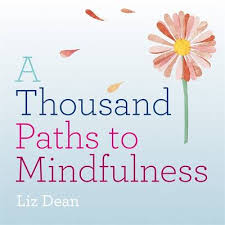
Book Review: A Thousand Paths To Mindfulness by Liz Dean

0

This beautiful little hardback book has a simple but beautiful design and is full of inspiring words of wisdom and mindfulness quotes.

Each chapter contains a collection of mindfulness quotes, proverbs, sayings and snippets of advice to help us on our mindful journey. The book is perfect for dipping in and out of whenever you need a reminder to stay present. The mindfulness quotes are inspiring and calming. This book is a great resource for anyone wanting to live more mindfully who is too busy to study the practice and read long heavy books about the subject.

The book starts with an introduction, which explains what mindfulness is. The author tells us that ‘we don’t need to sit cross-legged meditating on our own for hours because mindfulness is an attitude we can practice any time’.

The book is divided into 8 chapters each with a different theme

1. Being in the moment

This section focuses on having a mindful outlook on life. It opens with a quote from Jon Kabat-Zinn ‘Mindfulness means being awake. It means knowing what you are doing.’ Each of the quotes in this section explain a little bit more about what mindfulness feels like and how to go about achieving it. Some of the quotes may be familiar, such as, ‘Why is the present called the present? Because it is a gift’. To more unusual words of wisdom such as ‘Chase butterflies and they will never be caught; watch butterflies and they will come to you.’

2. Finding peace and calm

As you would expect, this chapter is full of mindfulness quotes on being calm and peaceful. Most of these are quite short, but they provide powerful reminders that we can choose how we want to feel. Many of the quotes remind us of this such as, ‘Choose to be calm. It is an option.’ But the author also reminds us that this is not always as easy as it sounds with words like, `It’s easy to be an angel when no one ruffles your feathers’.

3. Minding our thoughts

This chapter encourages us to realize that we have more control over our thoughts than we might think. It includes classic advice such as, ‘It’s not what happens to you, but how you react that matters,’ as well as more challenging advice such as, ‘You wouldn’t fill your house with garbage. Treat your mind with the same care.’

4. Facing fears

This section on facing fears is inspiring. As well as calming our fears, it encourages us to go forward in our lives with courage and self-belief. The most useful piece of advice in this chapter for me was ‘Learn to accept that you are not perfect – nobody is.’ There is also a lovely page on walking in nature being a solution for many troubles. I also loved, ‘Let wonder replace fear’ though this seems like it might be harder to do than to say!

5. Loving kindness and self-compassion

The classic advice in this section is a quote by Soren Kierkegaard –‘Don’t forget to love yourself.’ The quotes in this chapter are all warm and life affirming. It was also lovely to be reminded of the following passage from 1 Corinthians, ‘Love is patient and kind; love is not jealous or boastful; it is not arrogant or rude.’ Another short but powerful quote is ‘Love grows by giving.’

6. Creativity and success

I eagerly looked forward to reading this section as creativity is such an important part of my life. I was not disappointed. The advice was inspiring. ‘One cannot live a creative life without first letting go of the fear of being wrong’, being a great example. Another inspiring example is, ‘Don’t give up on your dreams. With passion and attention, you can’t go wrong.’ I sincerely hope that this one is true!

7. The wisdom of patience

I readily admit that patience is not one of my strong points. So I delved into this chapter with some trepidation. I needn’t have worried. As with the other sections of this book, the mindfulness quotes are comforting and compassionate. I found particular solace in the following, ‘Patience comes into being when the brain discovers its fallibility and forgives itself.’ This section is full of many more gems of wisdom on the subject of patience.

8. Living with awareness

My favorite mindfulness quote from this section is, ‘Where you are, with what you have, do what you can’. With all the pressures of modern society to be the best and most successful person and to be perfect at everything, I found this quote very reassuring and comforting.

The final quote of the book is from Sharon Salzberg, ‘Mindfulness isn’t difficult, we just need to remember to do it.’

Liz Dean has created a wonderful book for anyone feeling stressed or anxious or anyone that just wants to stop and smell the roses from time to time. With this little book close at hand I feel I will be reminded to be a little more mindful every day.

Overall Rating: I enjoyed this book so much and only giving this book 10/10 will do justice to this book.


SSVT

0

SSVT

What Is The Meaning of Divine?

0

Divinity is a recurring concept throughout Hinduism and other world religions. The word ‘divine’ has become associated with God or other supernatural being – a power that is greater than man.

Ancient texts originating from India talk about divinities in reference to the many Gods of the Hindu pantheon. These texts appear to have influenced the myths of later civilisations and modern day religions.

Although it is said there are some 330 million gods in Hinduism, divine Yogis understand there is just One Supreme God – Brahman – which is personified by the Trimurti; Brahma, Vishnu and Shiva.

The Trimurti are the Highest Divinities of the Hindu pantheon. Yet Hindus with an in-depth understanding of the True Self – the Atman, realise that the Trimurti are merely aspects of our inner life.

Essentially, human beings have the potential to become God-like by connecting with the ‘divine’ power that is within us. The divine power within us is the Atman and we connect with the Supreme Universal Divinity which is the mysterious Brahman.

God in Man

Hindu texts written thousands of years ago teach us how to develop the qualities of divinity. Religious texts make no bones that God resides in man. The Svetasvatara Upanishad describes the Atman as the God that resides within.

Similarly, in the Christian Bible, Genesis 1:27 states: “God created mankind in his own image.” Although the Catholic Church personifies God as some supernatural Sky Daddy, the texts imply that man has the divine qualities of God if we choose to discover our true Self – the Atman – the God that resides within.

In the Bhagavad Gita, Lord Krishna talks about the ‘divine mystery’ being a royal secret. Kings, crowns and thus royalty are used in esoteric symbolism to represent Yogis – enlightened beings.

This ‘royal secret’ is knowledge that can only be gained through self-examination. Eventually, the process of self-examination results in a revelation – the point of self-realisation, or if you like, an understanding on an deeper, emotional level.

A spiritual aspirant therefore has to search for the divine power within. And the God in ancient myths demonstrates what we have to do in order to become an enlightened soul and ‘see the face of God.’

Where is the divine power within?

This is a question that is open to debate. Yogis teach us that we can access our divine power through the breath. By breathing from the pit of the stomach and using the whole diaphragm, we fall deeper into trance.

In deep meditation, we are able to access levels of consciousness which connect us to the divine. By training the mind to empty and concentrate on an intention, you can explore and discover the divine in you.

The ancient Chinese call this energy centre the Tan Tien. This is where the chi energy starts. Hindus have a similar concept which explains how the chi energy emerges and passes through the chakra system.

The Tan Tien is situated about an inch below the navel, in the middle of the sacral chakra and the solar plexus chakra. These are arguably the two most important chakras – although this is open for debate and many people will have alternative opinions.

My reasoning behind this statement is because the sacral chakra is the energy centre for creation. The ancient Sanskrit word for the sacral chakra is Svadhisthana which means ‘dwelling place of the Self.’ In other words, where the Atman resides.

Atman remember is the individual God that resides within – your personal divine power that connects you to the Universal divinity which is Brahman.

The Solar Plexus chakra is regarded as the control room. This powerful energy centre can be used for burning away old values that no longer serve us in order to bring in new values. Among the Hindu Gods the Solar Plexus is the divine power of Shiva and Shakti.

So together, the sacral chakra and the solar plexus chakra can be used to help us transform from an ordinary mortal and develop the divine qualities reflected in the mythological Gods.

The qualities of a divine Being

Yogis explain that to access divine knowledge, we must transcend the bounds of reason and logic that we typically apply to things in the physical world.

When we let go and allow our minds to wander beyond the five physical senses, we connect with our divine self and acquire knowledge that enables us to dissolve the ego.

Throughout history we have heard stories about these revelations being grandiose epiphanies – visits from God. In reality, self-realisation is far less dramatic, although is usually accompanied by feelings of light-headedness and a release of tension felt leaving the body. We tend to call them ‘Eureka moments’ or ‘ha-ha moments.’

The truth about yourself comes from within. By internalising your thoughts and examining your actions, you understand more about yourself. This is how to connect with your higher self and expand your conscious awareness.

Understanding Hindu myth acts as a guide. In chapter 16 of the Bhagavad Gita, Lord Krishna explains to Arjuna that divine virtues will come to any man that nurtures the divine qualities.

The Vedas inform us that divine qualities are fearlessness, love, gratitude, appreciation, compassion, patience, honesty, control of emotions and purity of mind.

Men that oppose the qualities of divine beings in Hindu mythology develop demonical qualities that we find in the Asuras; ignorance, anger, arrogance, hate, selfishness, materialism, indulgence, boastfulness and jealousy.

As children we develop the qualities of the Asuras because we do not know any better unless guided by adults; parents, teachers, spiritual leaders etc.

Sadly, many of us our misled by the glamorous ideal of a life you can have. The images painted by magazines, TV and films promise a life of grandeur. In essence, these fantastical ideals steer us away from the inner Truth of the divine Self.

So essentially, you have a choice. Chase a non-realistic dream that magazines promise. Or look within, touch the divine Self and create the life you want for yourself.

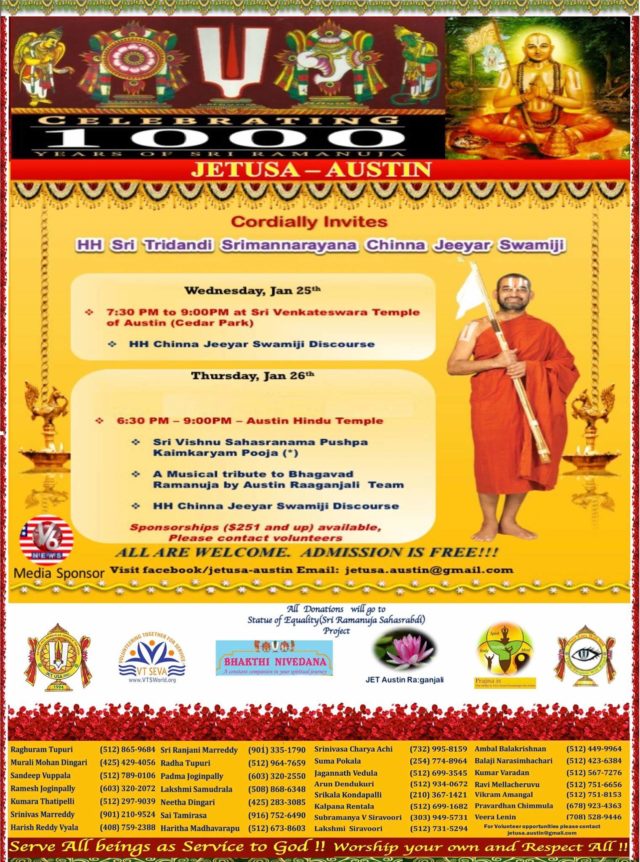
2017 Chinna Jeeyar Swamiji Discourse in Texas

0

Event: Chinna Jeeyar Swamiji Discourse in Texas

When: 01/25/2017
Time: 7:30PM to 9:30PM
Where: Sri Venkateswara temple of Austin, TX ( Cedar Park)

When: 01/26/2017
Time: 6:30PM to 9:00PM
Where: Austin Hindu Temple

Yoga App Review: Yoga Nidra – Deep Relaxation Practice by Elizabeth Papadakis

0

Yoga Nidra is a method of inducing complete physical, mental and emotional relaxation. It involves withdrawing the awareness from the senses and turning inwards.

The YogaNidraLite app contains a 10 minute Yoga Nidra Meditation and extra guides and information. Within the app, you are guided through the meditation by a professionally trained Yoga and Meditation teacher.

The teacher has a pleasant and relaxing voice. Initially, the teacher explains the correct posture for the meditation (lying down). He suggests spending enough time to get in a position you will feel comfortable in for the ten minutes.

Following this, the practice moves on to taking three deep breaths and feeling a wave of relaxation on the out breath. Next, there is a short progressive relaxation of the whole body. After this, the next step is to focus on the sounds around you, including the sound of your own breathing.

This meditation then moves on to a body rotation exercise. In this exercise, the pleasant voice of the teacher guides you through becoming aware of each part of the body. After this, you are guided into an awareness of the body as a whole. The meditation then guides you to become aware of both the body and your breathing.

Within this app, there is also an excellent guide to getting the best from your Yoga Nidra Practice. This guide includes information on the correct position, remaining awake and choosing a suitable place and time for your practice.

Finally, the meditation moves to a further breathing exercises before the close of the practice.

This is a great app if you are feeling stressed or anxious. It also promotes deep and relaxing sleep. The meditation left me feeling wonderfully refreshed and relaxed. I thoroughly recommend this app and it has quickly become my favorite meditation. Try it – you won’t be disappointed.

An upgrade for this app is available for £3.99. The upgraded version include three meditations of different lengths, 10, 20 and 30 minutes each, and contains no advertising.

Further information

This app is available on iOS

For further information visit itunes.apple.com

Features: 9/10
Ease of use: 10/10
Information 10/10
Overall rating: 9.5/10

What’s New in Yoga January Edition- SuperBrain Yoga and More

0

Keep up to date with the yoga community with our monthly round-up of what’s new in the world of yoga, from superbrain yoga to yoga for men

SuperBrain Yoga Can Improve Your Mind

SuperBrain Yoga is an exercise that can help to improve your brain’s sharpness and clarity. It’s a simple technique, which proposes to increase intellectual capacity and sharpen both memory and concentration. SuperBrain Yoga is a form of acupressure and breathing technique that helps to bring energy up to the brain and balance both hemispheres of the brain. Additionally, SuperBrain Yoga reduces stress, improves psychological stability, and promotes proper brain function.

The method is scientifically validated by Queensland Academics.

SuperBrain Yoga is really easy to learn and only takes three to five minutes per day. Queensland Academics says the practice synchronizes the brain’s Alpha waves, resulting in increased energy in the mind.

How to Practice SuperBrain Yoga: Step-by-Step Instructions

Ideally, practice this exercise in the morning. This will help to improve concentration and relieve stress throughout the day.

Follow these seven steps:

  • Remove all jewelry and stand up straight.
  • Place your tongue on the roof of your mouth right behind your teeth (as if you were about to say “La”). Leave it there throughout the exercise.
  • Take your left hand and cross your upper body to hold of your right earlobe with thumb and forefinger. Make sure that the thumb is in front.
  • Now take your right hand across your upper body to hold of your left earlobe. Again, make sure that the thumb is in front. At this point, you’re pressing both earlobes simultaneously. Make sure your left arm is close to your chest and inside your right arm.
  • Inhale through your nose and slowly squat down to the ground.
  • Hold your breath and do not exhale until you start making your way back up to a standing position.
  • Repeat this squatting action between 15 and 21 times. Remember to keep holding your earlobes and to keep your tongue touching the roof of your mouth throughout the entire exercise. You may not notice a change immediately, but after a few weeks, an improvement in concentration should become apparent.

Yoga is Gaining Popularity Among Men

Up to 70% of yoga practitioners are female. However, the practice is now gaining popularity among men. The Yoga Alliance reports that the number of men participating has increased from 4 million in 2010 to 10 million by 2016.

This growth has been fuelled by an increase in yoga websites and resources targetted towards men such as Broga Yoga, Dirty Yoga, and Man Flow Yoga. These sites offer workouts specifically designed for the male body.

The popularity of yoga among men has, no doubt, also been helped by celebrity yogi’s, such as music producer Russell Simmons.  Simmons is an aficionado of the practice and recently opened his own yoga center, Tantris, in LA. Undoubtedly, an increase in male stars talking about their experiences of yoga has helped move yoga beyond its image as a female orientated practice.

A further factor that may be leading to more men becoming involved in yoga is the increase in popularity of couples’ yoga. In this form, couples practice together using partner poses.

Yoga and Meditation Added to US School Programs

Schools in the US are increasingly using yoga and meditation as part of the school curriculum.

School children at the Robert W. Coleman Elementary School Baltimore, Maryland are learning yoga exercises and meditation skills. The aim is to provide them with better tools to deal with the daily struggles they face.

Principal Carlillian Thompson brought the program to Coleman in 2010. Thompson regularly sends some of her most troublesome students to the Mindful Moment Room instead of requiring them to stay after school in detention.

In San Francisco, the School District partnered with a local organization called the Center for Wellness and Achievement in Education. The center brought a meditation program called Quiet Time to Visitacion Valley Middle School and three other schools.

Each day, during Quiet Time, the whole school has two 15-minute periods of Transcendental Meditation (TM). TM is a process for slowing down unwanted thoughts and reaching a state of calm awareness.

The results are promising. Suspensions at Visitacion Valley have fallen by 79 percent over a four-year period with attendance rising to 98 percent.

How Do Hindus See God?

0

Although there are many gods in the Hindu pantheon, the question remains how do hindus see god as Hindus only believe in one true God. This ‘Supreme’ God is called Brahman and is present in each and every living thing.

Brahman lives in the soul of animals and humans as atman – the true self. Atman belongs to Brahman in living creatures and enables us to function. But it is the Supreme God, Brahman that gives us life and determines what we experience.

Hindus say Brahman is absolute consciousness. The only true God is omnipotent, omnipresent and omniscient. Brahman is the one true creator of the Universe and is imperishable, undying and ever-present.

What are the three key aspects of Brahman?

This concept of Brahman is expressed succinctly by the three Supreme Gods of the Hindu Trinity – the Trimurti of Brahma (the creator), Shiva (the destroyer) and Vishnu (the preserver).

The Trimurti address the essence of life. And everything in life moves in cycles – including human consciousness. We have to learn how to do things to cultivate more depth of conscious awareness.

So Brahma is the spark of life that comes into existence. In human terms, this is the thoughts that triggers an idea. Without thoughts, nothing that is manmade comes into being. This is why the God Brahma is known as the creator – and why it is said that you create your own luck in life.

Shiva destroys aspects of creation that we don’t need. For example, when you begin a new project – a new cycle – you may have to learn new things.

But if these new things are not in your programming, you will make mistakes or feel uncomfortable. So you may have to adopt a different attitude or world view. Which means destroying old habits and thought patterns to make way for new habits.

This concept is symbolized in religions by the idea of death and rebirth. So as Shiva destroys, Brahma creates. It is then Vishnu’s role to preserve the new habits and attitudes so you can enjoy more success in your proceeding cycles of life.

The Trimurti Gods, Brahma, Shiva and Vishnu are also seen in philosophical terms by Hindus. The concept is essentially the same as the religious view, but by combining the two it helps to understand how Hindus see God on a deeper level.

The Philosophical view of Hindus Gods

The ancient sages of India described God as having many aspects. As mentioned above, the all-pervading power that we call ‘God’ is known as Brahman. The other two aspects are the inner God, Antaryami, and the individual soul, Bhagavan.

But together, Brahman, Antaryami and Bhagavan are all seen as aspects of God throughout the Universe, Earth and individuals.

Therefore, whilst Brahman is considered the “all-pervading world soul” Yogis know that Brahman still lives inside them as they are part of the world. In the Bhagavad Gita, Krishna says:

“The Supreme Lord is situated in everyone’s heart. 0 Arjuna, and is directing the wanderings of all living entities.”

Therefore, Hindus accept there are many ways to receive God and feel his presence. And thus they also realise that God’s Brahman is to understand the changing nature of oneself so you can discover Atman which leads to Moksha.

Consciousness is one. God is one.

In the Sanskrit poem, Vivekachudamani ascribed to the 8th Century philosopher, Adi Shankara, “Brahman is the only truth, the world is unreal, and there is ultimately no difference between Brahman and Atman.”

So just as Brahman is universal consciousness and atman is the true self of the individual, finding our true nature through self-realisation is how Hindus see God.

To help initiates of Hinduism understand this, the ancient sages used the expression ‘Antaryami’ to explain that the Brahman God residing in our hearts enables us to take control of our thoughts, emotions and actions. This is a concept you will recognise in the Trimurti from the explanation given above.

Author Brian Warner, describes Antaryami as, “the controller within” – the Supersoul Hindus call atman or Paramatman. The Supersoul is perceived by the conscious mind through experiences which become instinct, intelligence, memories, abilities and so forth.

So essentially, the controller within is the sub-conscious mind which enables the Supersoul to express itself on the physical plane. This is the Brahman, the all-pervading consciousness experiencing a different reality.

It is common therefore for Hindus to meditate on the antaryami, the God inside as it is this force of consciousness that determines their thoughts, emotions and actions.

And it is this triangle of manifestation by which we are judged, both physically by others and spiritually by Supreme consciousness – the energy that manifests as reality. This is the unlimited power Hindus call Bhagavan.

God is unlimited power

Whatever action we take in life, we receive the consequence of that action, because for every action there is a reaction. This is the Universal law of Cause and Effect. And the ancients seemed to have a profound understanding of how it worked.

In the Katha Upanishad it is written:

“Those in whose hearts OM reverberates
Unceasingly are indeed blessed
And deeply loved as one who is the Self.
The all-knowing Self was never born,
Nor will it die. Beyond cause and effect,
This Self is eternal and immutable.
When the body dies, the Self does not die.

The ancient sages of India therefore applied one more piece to the philosophical puzzle of God; Bhagavan – “one who is endowed with unlimited opulence.”

Bhagavan is a word that is attributed to individuals that have six qualities, or “six opulence’s”; strength of character, wealth, knowledge, beauty, renunciation and fame.

The six opulence’s can be misleading. Fame does not necessarily mean you have to be famous in the common sense of the word, but recognised for what you do. Wealth does not mean material wealth, but richness of the heart and character.

Hindus recognise that the Supreme God of Brahman and Atman give us these six qualities. And this is why Hindus see God as one presence that resides in each of us yet is everywhere all the time.

So think with your head, feel with your heart and act in accordance with the six opulence’s, and you will see God in the same way Hindus see God.

App Review: Ayurveda Remedies and Prevention

0

This app is focused on the health benefits of Ayurveda and offers advice and guidance on how to use Ayurveda remedies for better prevention of illness and improvement of existing ailments.

This app contains 3 sections

  • Daily tips
  • Remedies and prevention
  • Food and health 

Daily tips

In this section, there is a daily tip. However, I don’t think this is updated every day. You can refer to previous tips here, too. The tips covered include a good range including a natural tooth powder recipe, a drink for fat reduction and home remedies for depression. Clicking onto the daily tip gives further information and if appropriate a recipe with ingredients and method so that you can make your own treatments.

Remedies and prevention

This app includes hundreds of natural Ayurveda remedies. The list includes many conditions from acidity to yeast infection. It also covers more serious diseases such as cancer and heart illness. The Ayurveda remedies are often made from simple ingredients found in the home kitchen.

Other examples include of remedies and guidance include subjects such as:

  • Acidity
  • Eye care
  • Food poisoning
  • Haemorrhoids
  • Insomnia
  • Menstrual-Problems
  • Obesity
  • Sunburn
  • Urinary Tract Infection
  • Wrinkles
  • Yeast Infection

Food and health

This section contains many diet and health articles in the form of lists of food good for certain conditions. For example, one topic is 10 best foods to fight aging. This section lists healthy greens, whole grains, berries, olive oil, tomatoes, nuts, red grapes, fish, tea and herbs, and spices. The health benefits of these foods are explained and there is a picture of each one to help you identify more unusual items.

This section gives Ayurveda remedies for blood pressure, fat burning, weight loss, liver cleansing and many other ailments. Also included are sections on Ayurvedic eating, healthy diets, superfoods, detoxing and much more.

The positive benefits of using this app

Overall this app provides good information. A great range of Ayurveda remedies is covered, though it isn’t completely comprehensive. The section on food provides a handy place to go to find health information for specific needs such as losing weight or liver cleansing. The app is also helpful in deciding which foods to include in the diet for maximum benefits.

The app is made by Apps-World is and free on iOS

Features: 6/10
Ease of use: 8/10
Information: 7/10
Overall rating: 7/10