Along with meditation and yoga, actively practicing mindfulness can really bring harmony and sense to your life. So, what is mindfulness? Essentially, it means being completely and totally in the moment with whatever you’re doing, whether you are driving to work or cooking dinner. Instead of drifting off into another world where you are surrounded by homework, deadlines, anxiety and stress, being mindful means ridding yourself of those distractions and simply being present. Now, I understand that this is way easier said than done. I know that if I am taking the dog for a walk, sometimes I start planning out what I need to buy for dinner that night or mentally scheduling the rest of the week. Lately, though, I have been actively trying to clear my mind and instead embracing the moment. Here are some tips and tricks you’re going to need if you want to start being more mindful.
1. Pay attention to your breathing. Obviously it’s a very natural thing to do, but have you ever noticed sometimes you will sigh more frequently or start breathing more rapidly when you’re stressed? Take note of that and work with your body – what is it telling you that you need? If you’re stressed, take a few deep breaths and wait until it picks up its natural rhythm again. Even if the moment strikes at an inconvenient moment, like at a work meeting, make sure you acknowledge it.
2. Listen to your friends and family. Put down the phone! Stop texting! Unplug for the evening! We tend to take for granted the ones closest to us. Have you ever been in the middle of a serious conversation and then reached for your phone mindlessly? It’s a very twenty first century problem – we scroll, tap and type our way through important meetings and moments. It needs to stop, and an easy way to start implementing tech free nights is by getting everyone you are surrounded by on board. If you are at a family dinner, make everyone put their phones in a basket and put it out of arms’ reach. That way you are more likely to engage and connect.
3. Connect with your body. This means not only being mindful of what you are putting in your mouth, but also taking into consideration your own emotions and feelings. When I am having a particularly difficult day, instead of ignoring it or spending the next few hours mindlessly scrolling and eating, I will force myself to listen to the pain I am feeling. What do I really need at this moment? Is it a sandwich or some time to myself to unwind? The more In-tune with your body you become, the easier it is to be mindful in your everyday life.
Practicing mindfulness should be one of the first steps you take to get to know yourself better. You’ll have to deal with some of your own personal problems as well as problems with people in your immediate circle. Once you start delving deep into issues and really have to be present in the moment (even if it is an uncomfortable one) you will soon come to the realization that being at peace with yourself is a necessity in the world we live in.
Iyengar yoga is a deep and meditative form of yoga that focuses both on the proper alignment of the body and on creating awareness in the mind. Studies have proven that Iyengar yoga can be healing for both the mind and body
Iyengar yoga is a form that pays attention to proper alignment in each pose. The focus is on symmetry and also awareness through meditation and breathing. Benefits of Iyengar yoga include toning muscles, eliminating tension, easing chronic pain and relieving depression.
History of Iyengar yoga BKS Iyengar, who studied yoga in India from the age of sixteen, developed Iyengar yoga. He created the form to focus on the precision of yoga poses (asanas) and correct breathing practice (pranayama).
Iyengar has written 14 books, the most famous of which is Light on Yoga a key text in the yoga community. At the age of 95, Iyengar is still teaching and practicing yoga.
What makes Iyengar yoga different from other forms? In Iyengar yoga, the emphasis is on correct anatomical alignment within each asana. The aim is to ensure healthy alignment of joints, ligaments and muscles. Iyengar yoga makes use of props, such as blocks, straps and chairs to help each student achieve correct alignment within the asana and to allow students to go more deeply into the poses. This makes the practice suitable for beginners and experts alike and also those with physical limitations, as the poses can be adapted to the individual with the support of the props. By strengthening weak areas of our bodies and opening and stretching tight ones, our bodies return to their correct alignment.
Poses are held for a longer time than in may forms of yoga, which allows for deeper levels of muscle stretching. The slow pace also helps develop higher levels of awareness, by providing focus and stilling the mind.
Iyengar yoga instructors have to complete a rigorous period of study to attain certification. This means that students can rely on their Iyengar yoga instructor to be deeply knowledgeable about the practice.
The health benefits of Iyengar yoga Iyengar yoga targets multiple ailments including physical disorders such as high blood pressure and chronic neck and back pain. The practice also targets emotional and mental issues such as depression.
Studies have looked at the benefits of Iyengar yoga and German researchers found that when they compared Iyengar Yoga with a self-care exercise program among people with chronic neck pain, yoga reduced pain scores by more than half. Examining yoga’s effects on different kinds of chronic pain, UCLA researchers studied young women suffering from rheumatoid arthritis. About half of those who took part in a six-week Iyengar Yoga program reported improvements in measures of pain, as well as in anxiety and depression.
As Iyengar instructor’s focus on both alignment and inner awareness, the practice is healing for the mind and the body. By practicing this form of yoga you will develop a thorough and correct understanding of the asanas, which will be useful if you choose to add a different type of yoga to your practice.
Yoga is about much more than physical exercise. The practice is designed to align the mind, body and spirit. However, to get the most out of your yoga practice it is helpful to understand a little about the philosophies behind the practice.
An estimated 2000 years ago, the Indian sage, Patanjali collected together the tenets of Yoga into the Yoga Sutra. The Yoga Sutra is a collection of 195 statements that outlines the practices and philosophies of yoga.
The Yoga Sutra outlines the disciplines of yoga, which are known as the eight limbs of yoga. These are:
In the practice of yoga these eight limbs are explored first in the outer world and then by focusing inward to reach Samadhi, which is also known as enlightenment.
Hatha Yoga
Hatha Yoga is one of the most popular forms of yoga and is ideal for beginners. Hatha Yoga is any form of yoga that includes physical poses or asanas. Most forms of yoga in the West can be classified as Hatha Yoga. The word hatha means the sun (ha) and the moon (tha). The sun represents the masculine and the moon the feminine so Hatha yoga means finding a balance between these masculine and feminine forces. The masculine forces are hot and active while the feminine are cool and receptive. A balance of these energies is needed for the body, mind and spirit to be in harmony.
On a physical level, Hatha yoga develops strength and flexibility. The strength is the masculine and the flexibility the feminine, so the practice of yoga helps us to balance these forces of action and surrender.
On a mental and emotional level, Hatha yoga is a powerful tool for self-transformation. It requires us to bring our attention to our breath, which helps us to still the mind and be more present in the unfolding of each moment.
Hatha yoga also prepares the mind and body for meditation and, in this way, fully balances the mind body and spirit. Most Hatha yoga classes will end with a period of meditation guided by the teacher.
One of the most well known sequences in Hatha Yoga is the Sun Salutation
Sun Salutations Sun Salutations, which are known as Surya Namaskar in Sanskrit, originated as a prayerful way to give thanks for both the sun and the spiritual light within us. The original Surya Namaskar was a sequence of sacred words, Vedic mantras, to honor the sun and these were traditionally chanted at sunrise. Physical movements such as bowing and raising the arms may have accompanied these. These rituals date back thousands of years and have gradually developed into the Sun Salutations we recognize today.
The Sun Salutation consists of eight postures and is easy to learn. There are many classes, videos and books that can teach it. The best way to get started with Hatha Yoga is to attend a class with an experienced teacher. The teacher will be able to ensure each pose is done properly for the full benefit and to prevent injury.
However you choose to begin your Yoga practice, to get the most out of it, remember that it is about more than your body. Yoga is a holistic practice that can help you live a healthy life physically, mentally, emotionally and spiritually.
Kundalini Yoga derives its name from the focus on awakening Kundalini energy through regular practice of meditation, pranayama, chanting, mantra and asana. While Kundalini yoga is physical, it has a clear focus on the spiritual elements of life, particularly on balancing the chakras and changing perception.
In ancient eastern religions, it was believed that at the base of the spine there lies a source of divine energy, like a coiled snake. Kundalini yoga is a method of learning to uncoil this serpent power and draw it up through the seven chakras so we can step into our divine potential.
Kundalini yoga uses sound, breath and posture to achieve this awakening.
Serpent power
Uncoiling the snake through Kundalini yoga is a powerful experience and should only be undertaken with the proper guidance. All forms of energy can be creative or destructive depending on how they are used; so working with this energy should be undertaken only with guidance from a proper teacher.
The whole yogic system is aimed towards enhancing perception, because you can only understand that which you perceive. This is the reason the symbolism of the snake is used. When the snake energy has reached the top of the head it means the third eye is opened, heightening perception and awareness. If the third eye has opened, it means another dimension of perception beyond the physical world of our senses has opened up, allowing us to look inward and become aware of the divine.
Raising Kundalini energy helps you to experience life more intensely. But it is not a power to be taken lightly. Many of us are subconsciously trying to raise our Kundalini energy, by meditating, praying, singing or even drinking alcohol. Kundalini yoga offers a framework to raise energy in a safe and properly directed way where it can be of true benefit to your life.
So what is a Kundalini class like?
• A Kundalini class begins by reciting a mantra to tune in.
• This is followed by some warm up postures.
• Then a set of postures called kriya is completed. A kriya typically has repeated postures practiced with varied breath work or chanting and it can also include dancing, yelling or chanting. There are different kriyas for different outcomes such as cleansing the liver or balancing the metabolism.
• The kriya is followed by a deep relaxation to balance energy, and calm the nervous system.
• The class ends with a period of meditation to help focus and calm the mind. The meditation may include breath-work, a mudra (hand position) and chanting.
Kundalini Yoga is probably the most spiritual style of yoga in the West. It is not a form to be dabbled in, but should be entered into seriously. With the right guidance Kundalini yoga could change your life. You can also combine the practice with other types of yoga that focus on the more physical aspects of the practice. If Kundalini sounds too intense for you, you can still experience the many benefits of other forms of yoga, all of which can help balance the body, mind and spirit.
Yoga is about much more than physical exercise. The practice is designed to align the mind, body and spirit. However, to get the most out of your yoga practice it is helpful to understand a little about the philosophies behind the practice.
An estimated 2000 years ago, the Indian sage, Patanjali collected together the tenets of Yoga into the Yoga Sutra. The Yoga Sutra is a collection of 195 statements that outlines the practices and philosophies of yoga.
The Yoga Sutra outlines the disciplines of yoga, which are known as the eight limbs of yoga. These are:
In the practice of yoga these eight limbs are explored first in the outer world and then by focusing inward to reach Samadhi, which is also known as enlightenment.
Hatha Yoga
Hatha Yoga is one of the most popular forms of yoga and is ideal for beginners. Hatha Yoga is any form of yoga that includes physical poses or asanas. Most forms of yoga in the West can be classified as Hatha Yoga. The word hatha means the sun (ha) and the moon (tha). The sun represents the masculine and the moon the feminine so Hatha yoga means finding a balance between these masculine and feminine forces. The masculine forces are hot and active while the feminine are cool and receptive. A balance of these energies is needed for the body, mind and spirit to be in harmony.
On a physical level, Hatha yoga develops strength and flexibility. The strength is the masculine and the flexibility the feminine, so the practice of yoga helps us to balance these forces of action and surrender.
On a mental and emotional level, Hatha yoga is a powerful tool for self-transformation. It requires us to bring our attention to our breath, which helps us to still the mind and be more present in the unfolding of each moment.
Hatha yoga also prepares the mind and body for meditation and, in this way, fully balances the mind body and spirit. Most Hatha yoga classes will end with a period of meditation guided by the teacher.
One of the most well known sequences in Hatha Yoga is the Sun Salutation
Sun Salutations Sun Salutations, which are known as Surya Namaskar in Sanskrit, originated as a prayerful way to give thanks for both the sun and the spiritual light within us. The original Surya Namaskar was a sequence of sacred words, Vedic mantras, to honor the sun and these were traditionally chanted at sunrise. Physical movements such as bowing and raising the arms may have accompanied these. These rituals date back thousands of years and have gradually developed into the Sun Salutations we recognize today.
The Sun Salutation consists of eight postures and is easy to learn. There are many classes, videos and books that can teach it. The best way to get started with Hatha Yoga is to attend a class with an experienced teacher. The teacher will be able to ensure each pose is done properly for the full benefit and to prevent injury.
However you choose to begin your Yoga practice, to get the most out of it, remember that it is about more than your body. Yoga is a holistic practice that can help you live a healthy life physically, mentally, emotionally and spiritually.
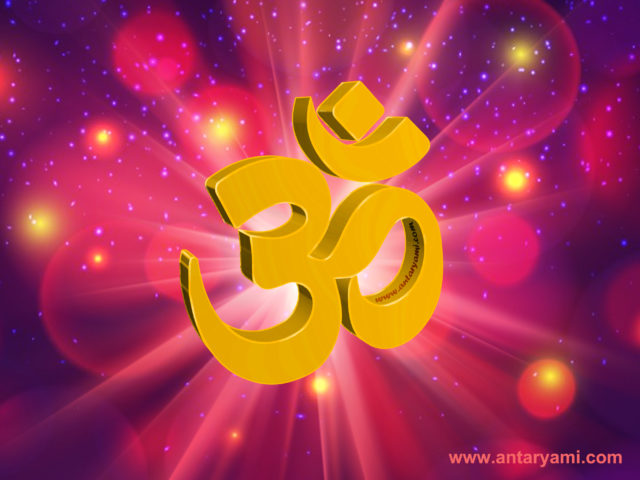
Hinduism is rich in symbolism which has deeply significant meaning – and none more so than the Aum. The word comes from Sanskrit which means the beginning and ending of everything – or absolute infinity.
It represents life, death and rebirth and is often used during chanting meditations to send vibrations throughout the body to help lift practitioners to a higher state of consciousness.
The Aum, sometimes spelt “Om” to reflect the sound of the word in English, is the symbol of creation and used as the signature symbol to represent Hinduism. In a sense, it is the equivalent of the cross, the Star of David and the Sun and the Crescent Moon in other world religions.
Needless to say, Aum is the most sacred symbol and characteristic of Hinduism. It represents all life and existence – a concept Hindus also refer to as “Brahman”; “the All”, “absolute reality”, “Truth.” Aum goes beyond all Hindu Gods to the very beginning of creation, to the end of dissolution and returns as reincarnated energy.
The ancient Sanskrit writers seem to have had a profound understanding of life, death and reincarnation. Nothing exists forever, but is transformed by the energy put into it. And this includes our lives whilst we are alive. Every seven years we grow a new coat of skin.
The Aum is also connected to our thoughts. We have a germ of an idea that fires as an electrical neuron in the brain and becomes part of our consciousness. Thoughts can be killed off by not acting on them, or they can be fueled with energy and manifest into reality.
Aum and the Hindu Trimurti
Ancient civilizations believed in a divine wisdom and that belief still holds true today in the form of God. In Hinduism, there are many Gods, although Hindus still believe in the one true god – the Supreme Self.
In actual fact, other religious texts say the same thing, even though they are not always explained in the right context. 1 Corinthians 3:16 of the New American Standard Bible says:
Do you not know that you are a temple of God and that the Spirit of God dwells in you?
But what is God? Religious texts tell us he is everywhere and in all things. Like atoms. Energy and matter. We are essentially energy and matter – and so is everything else in the Universe. Hindus believe we are all one, all connected from the same source and will return to the same source. This is Aum.
If God is within us and we are all one, it stands to reason that as God created the Earth, we are also creators. And modern thinking declares that we create our own reality just like the ancient writers explain.
Aum is broken down into three parts. A = creation; U = preservation; M = destruction. The creator, preserver and destroyer. These are the principal characteristics of the three Supreme Gods of the Hindu Trimurti.
Brahma is the creator God and has a direct correlation with how we think and behave. It is through thought, emotion and action – the triangle of manifestation – that we create our reality.
Once we have find a course of action that provides stability and purpose in our life, we need to call on the power of Lord Vishnu, the preserver who keeps the cosmic order of the Universe together.
The preservation of the cosmic order depends on how well we balance energies, and when we have an imbalance, our lives swerve off track. This is when we have to call on Lord Shiva the destroyer, to dissolve ego and rid us of limiting beliefs, attitudes and perceptions that are self-damaging.
Manifesting Aum
Whatever happens in your life is a result of what you manifest. Your experiences are a manifestation of cosmic energy in accordance with the cosmic laws determined by your thoughts, emotions and actions.
This is why most people keep encountering the same problems in life. Experiences run in cycles and when you keep doing the same things you have always done, you keep getting more of what you already have.
Life could be so much more simple if we understood ourselves, but as we pass through life, our perception of the world is shaped by our parents, peers, teachers and established institutions such as the media, religion and politics.
We are therefore pulled in all directions and do not understand our true self. We lose contact with the Supreme Self – the internal God that guides us through life. Essentially, we are not conscious of ourselves and live in a world of illusion that has been created for us.
Yet, we are told, we create our own reality. But not when we listen to outside influences. We are absolute consciousness and have to find our way back to the source to rediscover our Supreme Self. This is Aum.
For thousands of years, enlightened men have practiced meditation. This is the route back to the source. This is how we rediscover Aum. We know this from ancient writing, but none are so clear as Siddhartha Gautama, the historical Buddha.
Gautama was heavily influenced by Hinduism and understood Aum. Buddha labeled his discovery as “The Middle Way”, returning consciousness to center and finding balance. Which brings us back to the power of three we find in Aum: A-U-M.
The mind has three parts; reptilian, limbic and neo-cortex. The reptilian brain is our animal instincts, our basic need for survival and reproduction. The limbic system regulates our body and emotions and the most evolved part, the neo-cortex gives us the ability to analyze and calculate etc.
Consciousness works in the same way. At base consciousness we have desires, cravings which stem from the reptilian brain. Our ability to find solutions comes from the higher conscious mind which in religions is described as “the heavens” – where the Gods live.
The third aspect of consciousness is the conscious mind, or the habitual mind. This is the ego which either acts as auto-pilot or makes a decision based on information from our base conscious animal, or our higher conscious God.
We often swing towards base consciousness because our desires pull on emotions which are stronger than thoughts. As a result, we propel ourselves into action which generates the energy we manifest in our lives. This is Aum. The cycle of life. Creation. Death. Rebirth.
Vinyasa yoga is sometimes known as ‘flow’ yoga, because of the smooth dance-like movement through the postures and the way the movement is synchronized to the breath. Vinyasa actually means ‘breath-synchronized movement’. The breath acts as an anchor to the movement as you flow from one pose to the next in time with an in breath or an out breath.
Vinyasa Yoga is suitable for beginners as long as the class is chosen with care. It is also great for those with more experience who are looking for a more varied and dynamic form of yoga.
Here are just a few of the benefits of Vinyasa Yoga
You stay focused by going with the flow. In Vinyasa yoga you move through the postures (asanas) in a smooth flowing way and each pose is linked to an inhale and an exhale. A good Vinyasa instructor will keep the sequence of movements smooth and continuous. This flow can be great for helping you stay focused during the practice and preventing the fluctuations of the mind. This helps you to stay present in the practice, which is part of what yoga is all about.
It’s exciting and varied Vinyasa is a very flexible style of yoga. Where some forms of yoga repeat prescribed sequences, in Vinyasa teachers are free to choreograph the poses in any way they choose. This stops Vinyasa from getting predictable and boring. Music is usually incorporated into classes, which adds to the rhythm of the form.
It pushes you to your limits. Though it might sound easy and relaxing, Vinyasa actually works you hard and you will see improvements in strength, flexibility, and balance after just a few sessions. Vinyasa helps you move with grace and can have a powerful effect on your mind due to the focus the practice requires.
It’s a good cardio workout The continuous sequences of Vinyasa yoga provide a great cardio workout. Because you are moving more in this style of yoga, you will increase your heart rate and breathing and work up a sweat more than in some slower forms.
It is uplifting One of the most special things about Vinyasa is the beautiful flow. Being in a class where everyone is moving together gracefully and breathing together in time to the music can be a wonderfully uplifting experience.
It is suitable for beginners Since Vinyasa is so varied there are lots of classes available so it is easy to find one that suits you. This style is also a great way to learn the basics of pranayama, (yogic breathing), as the instructor will tell you when to inhale and exhale during each pose.
There are beginner sessions and courses available and it is well worth taking the time to do these because you will need a teacher who will explain the postures and alignments correctly. Some teachers assume you know the postures and can move through them without help. If you find a class is above your level, you should switch to one for beginners. If you attempt postures you are unfamiliar with without a teacher to help with correct alignment you risk injury.
It is also important not to push yourself too hard in Vinyasa. The muscles do need to be challenged but if they become over-tired this can put a strain on the joints.
To balance and enhance your yoga practice you might like to consider taking a class in a style that is more focused on the individual asanas and correct alignment, as well as combing different elements such as meditation.
3 Lessons I Learnt When I Started my Meditation Routine
If you’re anything like me, you’ll struggle with the demands of the world sometimes. Everyone wants you to be either at dinner, on the way to work or mindlessly scrolling through all your social media platforms. It’s a constant pull and tug that more often than not leaves you drained and stressed out. One of the reasons I personally started a meditation routine was to feel in control of my life at a time when the last thing I felt was in control! I was obviously searching desperately for something that was missing. Maybe I was lacking attention and love in my life or perhaps it was the fact everything around me was changing but I was staying painfully still. Either way, my mind and body told me I needed to do something about it. Meditation is whatever you make of it. If you spend 15 minutes sitting in complete silence, staring at nothing but the back of your eyelids and that works for you, then great! Figuring out what is going to be manageable for you is the first step. If you need a little more encouragement on why you should start a meditation routine today, then here are just some of the reasons I love daily meditation.
1. Setting aside a designated time just for you will improve the relationship you have with yourself. You truly are the only person you can ever completely rely on. You are your longest guaranteed relationship so you better make it a good one! I see meditation as a form of self-love and appreciation, and I am set aside precious time with myself instead of spending it with another person, watching TV or working. Meditation for me, helped prove to myself that I was capable of things I previously thought I wasn’t able to do. If you are looking for ways to actively practice self-love, then meditation should be on your to-do list.
2. You will learn to manifest goals. Manifestation is possible, believe me! As part of my meditation routine, before I center myself, I sometimes write down goals and achievements I want to make happen. Whether they are something small like finishing off de-cluttering my home or finally working on that book I keep talking about. If you want it to happen, it will. You will make it happen using manifestation. No, it won’t happen overnight, but give it time and really work on making those things happen and in time, they will.
3. It will give you some perspective. Things always seem more important and vital in the heat of the moment. What meditation does is – it gives you a moment of clarity. Did I really need to get frustrated over the traffic today? No, probably not, but I let it go during my meditation session. I forgave myself for overreacting to a silly situation and released it, and I didn’t think about that moment again!
Whatever your reasoning may be for starting a meditation routine, you will no doubt reap the benefits if you make it a part of your life. Good luck and happy meditating!
Meditation is an intensely personal experience. It came into my life at a time when I was a little lost and needed some guidance. Having been through some major life changes in the space of 12 months, I had never been more ready to start afresh. Alternative medicines and healing had always interested me, but when I realized I needed a change in my life, I didn’t know where to begin. Having practiced Bikram Yoga for some time I knew that yoga had the power not only to center my mind, but also help me connect with and understand my body better. I wasn’t sure though, how to start a meditation routine.
Prior to starting my own meditation practice, I had assumed it was the same for everyone. Close your eyes, quiet your mind and enlightenment will come straight away. That couldn’t be further from the truth. For some, it is relatively easy to block out any negative energy and focus solely on their breathing. For me, it was a struggle at first. Even during my yoga sessions, I was thinking about what I had to do before bed, reminding myself to put the washing on and don’t forget to give the dog his medicine. I knew that if I truly wanted to experience the healing power of meditation I had to make a conscious effort to shut my mind up!
After some trial and error, I discovered what worked for me. Having a daily ritual of yoga and meditation along with actively trying to be more grateful really started to help my mind, body and spirit. What it’s turned into is something I would never have expected. Each afternoon as the sun is sitting atop the trees in the distance I light my incense, grab whatever healing crystals I am attracted to that day, my yoga mat and go through my own little meditation ceremony. Instead of gravitating towards the poses, I feel comfortable with through Bikram. I try to focus on stretches and positions that are said to help quiet the mind. Depending on the day, I’ll practice anywhere from 10-20 minutes before plonking myself down on the mat to mediate. I have found it difficult to instantly shut off my thought process, so for the first few minutes I breathe deeply and go through all the things I am grateful that day. I find this helps me focus on the here and now rather than the past or future. With the incense filling my nose and the crystals vibrating happily at my feet, I slowly begin to fall into a state of complete quiet.
Everyone’s experience with yoga and meditation is different and perfect in its own ways. Take inspiration from others, but adapt them to suit your own needs. By doing this you are setting yourself up for success and happiness. Happy meditating!
What is yoga? Yoga is an ancient form of exercise that originated more than 5,000 years ago in India.
Yoga consists of sequences of physical poses, called asanas. The practice involves moving into these asanas while also focusing on relaxed breathing, to promote improved control of mind and body and to enhance well being. Yoga can be a great form of exercise and mindfulness in our busy stressful lives because, rather than focusing on competition and striving, the focus is on harmony and balance.
Through practicing yoga we can connect the movement of the body and the fluctuations of the mind to the rhythm of our breath. Connecting the mind, body, and breath in this way helps us to direct our attention inward and notice our habitual thought patterns in an accepting non-judgmental way.
What are the benefits of yoga? Yoga differs from many forms of exercise because it focuses on physical strength and flexibility as well as breathing and mental relaxation, to achieve a state of wellness that goes beyond mere physical conditioning.
There are many benefits to starting a yoga practice including: strengthening muscles, improving posture, alleviating tension and increasing flexibility. But beyond these physical benefits yoga can help us achieve a more balanced state of being by reducing stress and anxiety, and allowing us to be in a calm meditative state.
Is yoga right for me? Yoga is a great practice because it is suitable for everyone no matter how old or young or at what fitness level they may be. Yoga is suitable for those looking to improve fitness and flexibility and seeking a more meditative relaxed state of mind.
What do I need to start a yoga practice? Yoga is a great exercise because it takes very little equipment. All you really need to begin practicing yoga is your body and mind, but it is also helpful to have comfortable clothing that is not too loose. No special footwear is required because you will be barefoot. You may like to take a towel to classes but mats and other equipment will usually be provided.
There are a variety of classes and online courses available to get you started. Yoga can easily be done at home, thought it is worth taking some classes to begin with to ensure you are doing the postures correctly. As your practice develops you might want to buy your own yoga mat so you can practice at home.
What type of yoga is best for me? Yoga comes in many forms; from relaxing styles such as Yin Yoga to more dynamic forms such as Vinyasa, so there is a style suitable for everyone. All the various forms of yoga combine physical postures, breathing techniques, and meditation or relaxation.
Hatha Yoga Hatha is a term for any type of yoga that teaches physical postures (asanas). Hatha yoga classes usually offer a good introduction to yoga and are suitable for beginners.
Vinyasa yoga Vinyasa yoga is sometimes know as ‘flow’ yoga, because of the smooth way that the poses run together and become like a dance and also because movement is synchronized to the breath. The breath acts as an anchor to the movement as you flow from one pose to the next in time with an in breath or an out breath.
Kundalini Yoga Kundalini yoga incorporates asanas (postures), pranayama (breathing exercises) and meditation. A class typically begins with chanting and ends with singing.
Bikram yoga Bikram yoga is also know as ‘hot’ yoga and is held in rooms heated to temperatures of nearly 105 degrees and 40% humidity.
Iyengar yoga Iyengar pays attention to proper alignment in each pose. In Iyengar yoga, props such as blocks, blankets and chairs are often used to support the poses
Yin Yoga Yin yoga is a quiet, meditative yoga practice, also known as ‘Taoist’ yoga. Yin poses are passive and allow the release of tension in key joints including ankles, knees, hips, the whole back, neck, and shoulders.
Yoga has so many physical and emotional benefits, and is so easy to start, that it really is the perfect all-round exercise for the mind, body and spirit.