














Home Blog Page 37

How Vishnu Avatars Describe Evolution

0
vishnu

How Vishnu Avatars Describe Evolution

Have you ever been embroiled in an evolution versus creationism debate? The tussle between religious sects and scientists is getting out of hand. The real truth of the matter is they are probably both right.

The evolution of man is the expansion of consciousness which religious sects call God. Life first stemmed from consciousness. Let’s look at it this way; God is omnipresent, omnipotent and omniscient. In other words, “God” is everywhere and in everything.

Well, so is consciousness. Consciousness is nothing more than vibrating energy that form atoms – neurons and protons. And vibrating neurons and protons are found everywhere and in everything. They are omnipresent, omnipotent and omniscient. Scientist call this the law of vibration.

Scientists do not dispute universal laws, yet they fail to recognise cosmic energies as God because they do not want to believe there is a God. Yet the ancient word for law is ‘Lord’. Religious people that do believe in God pick fault at all the missing links of the theory of evolution and are adamant this is proof that God created man – despite hundreds of missing links in creation stories.

Ancient Sanskrit writers that produced the texts of modern day Hinduism explain the evolution of mankind by using the Supreme God Vishnu as a vehicle. Vishnu symbolically represents absolute consciousness – the source of creation that appeared after the Big Bang.

The scientific ‘theories’ taught as facts in modern schools have been round for thousands of years, but because ancient texts have been misinterpreted or passed off as myth for all these years, some of the greatest minds in history missed obvious clues. And some of the greatest minds in science today are still struggling to make sense of consciousness.

The first avatars of Vishnu

In Hindu mythology, Lord Vishnu is described as transforming shape to become a different creature or man. When you follow the sequence of reincarnations, you find the same patterns with which science explains the evolution of mankind.

Evolutionists say that the first forms of organic life formed from algae in the oceans and developed into fish. In the Hindu creation story, Vishnu reincarnates as the fish Matasya and saves Manu (the first man in Hindu) from the floods.

It is believed by evolutionists that land animals came from the sea in the form of amphibians. As the floods receded and there was not enough water, these amphibians evolved to have legs – as the theory goes.

In Hindu mythology, the second avatar of Vishnu is the turtle, Kurma. In the story of the churning of the ocean, a fight between the devas and the Asuras Lord Indra concerned so he asks Lord Vishnu to help.

Devas and Asuras are described as cousins and symbolically represent our higher conscious (devas) and lower consciousness (asuras). Lower consciousness is the habitual mind that so often caves in to emotional desires even when we know we shouldn’t do something.

Lord Vishnu advises the devas to churn the ocean of milk with Mount Mandarchal to produce nectar. However, Mount Mandarchal was too heavy for the devas to lift so Vishnu reincarnate as Kurma the turtle to support the mountain and help the devas produce nectar – in this case peace and harmony.

The evolution of animals to man

After taking the form of reptiles, the evolution of land animals miraculously diversified into thousands of different creatures, such is the nature of consciousness and its ability to adapt to its environment.

Vishnu’s reincarnation as an animal in the story of the Satya Yuga in which Hiranyaksha, a son of brahma becomes so arrogant he steals the earth and takes it to Pataal Lok. Vishnu transforms himself into the form of a boar called Varaha and defeats Hiranyaksha in a fierce battle.

The next avatar of Lord Vishnu is the Narasimha, a half man-half lion. This reincarnation is a follow-up to the story in the Satya Yuga and sees Hiranyakasipu, vying to avenge mankind for the death of this brother, Hiranyaksha.

The fifth avatar of Vishnu is described in the Puranas as Vamana, a dwarf-priest who reclaims the three worlds from the benevolent King Mahabali. This little man in the process of evolution reflects the onset of Neanderthals to homo-sapiens – human-like but not yet fully evolved.

We see the next stage of human evolution in Vishnu’s sixth avatar, Parashurama – often described as Rama with an axe. This period of history is said to be when man’s consciousness began to discover new ways of survival that would lead to the first advanced civilisations.

And then we have Rama, Vishnu’s seventh avatar which represents moral man and demonstrates how our evolution enabled us to develop knowledge and live life in accordance with cosmic laws.

Vishnu’s eight avatar, Krishna, is where we begin to see man fall apart. We have developed society and political rule, but in doing so the hierarchical structure has led us to becoming greedy and immoral. Corruption becomes rife.

The ninth reincarnation is Buddha, whereby man learns to return to his nature and fully understand cosmic energies that dictate our peace of mind and moral attitudes. It is when we are in a Buddha state that we are able to access god-like powers of consciousness that are innate within us.

This is the stage of evolutionary consciousness we are in at the moment, and we are already seeing signs of the next avatar of Vishnu, Kalki the superhuman. Although the story of Kalki is a prophetic work, we can see that recent generations of children have abilities that come naturally to them.

These gifts are often what we consider supernatural such as psychic abilities or the ability to produce huge amounts of energy to fire a lightbulb. Autism is another example of genius which modern society dismisses as a defect even when they have an IQ greater than Einstein.

Our innate gifts are not recognised in the modern world because we do not fully understand consciousness and misread ancient myths that use esoteric symbolism to explain how you can evolve your state of consciousness in your life time.
What Can The West Learn From Hinduism?

0
surya

What Can The West Learn From Hinduism?

Hinduism is the world’s oldest religion and is extremely rich in cultural and spiritual principles that are misunderstood in the West. This article looks to address some of the beliefs in Hinduism and reveal what we can learn from Hinduism, and show that all religious beliefs are fundamentally the same albeit taught in different ways.

One of the most important attributes we other world religions can take from Hinduism is to accept the views and values of other religions. This philosophy is ingrained into Hindu society because of the numerous gods and Hindu sects.

In Hinduism, people understand everyone is individual having a personal experience and can only follow the path they feel most drawn towards. The Rig Veda states: “In the world there are many different roads but the destination is the same.”

When we learn to accept one another as individuals having different experiences, there will be a lot less animosity. We do all have different paths in life our experiences shape our thoughts, knowledge, beliefs and actions.

What is dharma and karma?

In the West we typically consider Karma as “what goes around comes around.” It is the Universal law of cause and effect – the energy you put into something will manifest into reality.

This concept is deeply regarded in Hinduism and is an ancient world philosophy that explains the cycles of life. It is a good philosophy to follow to help break patterns of toxic thinking and behaviour.

The Bhagavad Gita teaches us to “perform always the work that has to be done (dharma), for man to attain to the highest (state of consciousness).

Karma is associated with the idea of reincarnation. Hindus believe the human soul has many lives that take different forms and it is our dharma that determines karma.

Will what we do in this life determine our reincarnation in the next life?

It is impossible to say how true this belief system is although it does make sense on many levels. Furthermore, what we can do is apply the teachings of dharma and karma in our everyday lives as it effects our current reality – and possibly future realities.

Every ancient philosophy and modern religion portrays the idea of death and rebirth. The story of Jesus dying on the cross and resurrecting from the dead is a good example for westerners.

But we find this concept repeatedly in Hindu mythology – typically in the legends of Shiva, the destroyer. Shiva is an aspect of our personality that gives us the courage and strength to change. Essentially, Shiva destroys ego.

When we learn to back down from our belief systems and change our attitudes, we overcome the basic patterns of ego that typically manifest in our formative years. When you are able to admit your failings and limitations, you will develop into a better person.

This is another meaning of dharma and karma. St Francis of Assis knew this. He said. “I die every day.” What he meant was he addressed his attitudes and actions every day then assessed himself using internal dialogue to discover ways he can improve himself.

At this point of enlightenment, it is pertinent to carry out your dharma and do the right thing. By doing so you improve your consciousness. Everything you think and do you become and experience. This is your karma and you control karma through your dharma.

The many Gods is one God

It is well known that Hindus worship many gods. This is bemusing to western traditions that believe there is only one god. But Hindus belief in one god too. They call it Brahman, the Absolute, or the Truth.

The gods, or devas, in Hinduism represent aspects of our personality. You find the same concept in all other ancient mythologies such as the classics, Celtic, Nordic, Mayan etc.

Modern religions have removed personifications from God and portray Him only as an omnipresent and omnipotent entity that is everywhere and in everyone.

The difference between the Hindu belief and western traditions is that Hindus understand the one God is The Self. Buddhists know this as well. The historical Buddha, Gautama Siddhartha said, “Each of us is a God.”

However, it is my opinion that many Hindu worshippers are still mislead to believe that the many gods in their faith are there to support and help them in times of need.

But the gods themselves will not help – it is the concept the Gods represent that will help you – because the power the devas hold is within you. This is written into all religious texts, but not always understood or taught by the church.

In other religions, the personality traits we need to adopt to become “god-like” are found in human characters. When you study stories from all religions, you will find the characters all share the same qualities; courage, patience, faith, righteousness etc.

Hindus worship the divine feminine

In the West, God is recognized as the Father – a male figure. But in the East, as in other ancient traditions, it was the goddess that is most revered.

In Hinduism, the female energy, Shakti, is regarded as the divine force that manifests things into reality. In ancient symbolism, the female principle represents emotion – things that come from the heart.

The male principle on the other hand represents the mind, the ability to think things through and analyse a situation. It is here we find a flaw in both religions as male and female principles should be given equal measure in order maintain balance.

Emotions impact thoughts. Without emotions there is no meaning to life, and without thoughts nothing is created. So we need to put both heart and mind into everything we do and respect the divine feminine and the divine masculine that is innate in each of us. We all have thoughts and emotions.

If you were to study Hinduism alongside Judeo-Christianity and Muslims you would find the same principles being taught – albeit in slightly different ways.

Hinduism is the world’s oldest religion. Buddhism stemmed from Hindu. It would appear other world religions did too. So let’s stop arguing with one another over which system is right or best and accept we are individuals having personal experiences. And it is up to us as individuals to connect with the God that is already within us.

Why Do Hindus Worship Idols As Gods?

0
Durga

Why Do Hindus Worship Idols As Gods?

Although ancient Hindu philosophies laid the foundations for all other modern day religions and is aeons ahead of modern science, there is a misconception regarding the practice of idol worship in Hinduism.

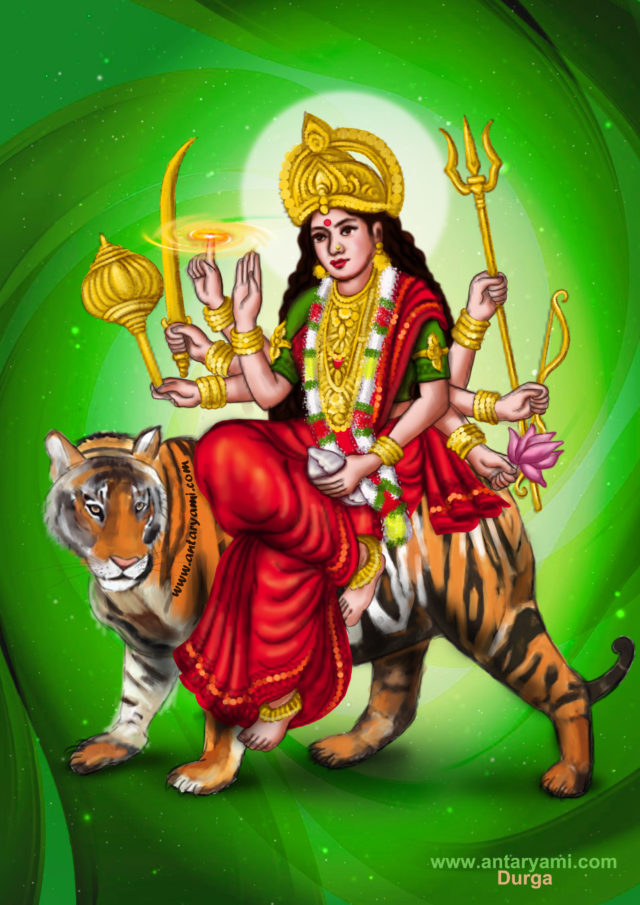
As we discussed in an earlier feature, the devas and asuras in Hindu mythology represent aspects of consciousness and human nature. Idols carved into the personification of said mythological characters serve as a reminder of the human consciousness they symbolize.

Hindus do not specifically worship these idols as gods, but rather the power vested in the idols that invoke the attributes of the gods. Everything is energy and vibration, and in accordance with Agama Shastra, Hindu idols are energized so worshippers can consciously reconstruct their own minds with the powers of consciousness present in the idol.

The manufacturing and energizing process of Hindu idols is an entirely scientific process. The same rituals have been followed for thousands of years. There is mention of idols in ancient Vedic literature, although this sacred knowledge had to have been known even before the oldest Vedas were compiled.

Mainstream science only realized the “myths” in the Vedas are grounded in universal truths around 60 years ago, although enlightened thinkers have been aware of energy, vibration and consciousness throughout the ages.

Even today, many scientists do not agree because in accordance with official history, they cannot accept that the “primitive” minds of the ancient man could know about scientific facts before modern science discovered it. So they just ignore ancient texts and call them “myths”.

The Tantric scientific methodologies described in the Agama Shastras are a prime example. Modern day scholars do not like to put a date on these sacred texts, but acknowledge they were written at least as early as the late Vedic period around 50AD.

What is most fascinating about the Shastras is they explain how temples and idols should be constructed to certain dimensions in order to create the right vibrational energy together with how mankind can come to self-realization through philosophical texts and meditation.

Furthermore, the information written by the ancient Hindus, at least 1500 years ago, talks about things that were only discovered by science in the 20th Century. Idols and temples are not created to prey upon anyone, but as objects from which people can benefit from their vibrational energy and invocation of the universal consciousness vested in them.

The science behind the Agama Shastra

The entire process of idol-making in Hinduism is a deep science. When an idol is manufactured, it is made to specific dimensions provided by the ancient sages in the Agama Shastra.

Idols are made with specific materials and energized is certain ways depending on the vibrational energy the creator wants the idol to reflect. This practice is known as Prana Prathishta and literally means to invoke the life force.

The life force is a degree of consciousness, a vibrational energy that we connect with. But we only connect with the level of vibration our consciousness allows. People that are more spiritually advanced and attuned to vibrational energies can tap into higher frequencies and receive greater knowledge.

This idea may sound fantastical, but the law of vibration is a scientific principle in physics and is included in the physical laws of the Universe. Albert Einstein said “Everything in life is vibration.” Furthermore, quantum physics has determined everything that vibrates has a consciousness.

Idol-making is a practice that makes it possible to manifest specific energies by matching mudras, the symbolic meanings of the gods, with mantras, the ancient philosophies that program our conscious awareness.

This concept is also a science that modern day Neuro-biologists are still coming to terms with. It has been given the label of neuroplasticity, but essentially it is a way of re-programming your mind by redirecting the neurons along the neural pathways in your brain.

Neuro-biologists have come to realize that it is possible to reorganize the neural networks by changing the way we think. The human brain is programmed as we go through life, and triggers thoughts and emotions in accordance to what we experience.

Because the system we live in is designed to keep us in a state of fear, ignorance and negativity, we typically have thoughts of self-doubt and worry, or simply blinded to the truth about our true selves and everything around us.

Hindus are taught from an early age that thoughts are vibrations, as this is a fundamental belief in their spiritual journey. Although it is not fully understood today, advocates have picked up on this principle and call it the “law of attraction.” Essentially, we have the power to create our own reality.

This is something quantum scientists discovered in the 1960’s in a now famous study known as the double-slit experiment which was inspired from an earlier experiment performed by Thomas Young in 1801. What quantum scientists found in the 1960’s was that the results changed depending on the pre-conceived idea the experimenter wanted the outcome to be.

R.C. Henry, a Professor of Physics and Astronomy at Johns Hopkins University states: “A fundamental conclusion of the new physics also acknowledges that the observer creates the reality. As observers, we are personally involved with the creation of our own reality. Physicists are being forced to admit that the universe is a “mental” construction.”

The All: One Universal Consciousness

The purpose of charging idols with positive energies reflected by mythological gods is to enable the worshipper to contemplate on the relevant aspects of their own nature. This is a process of self-realization.

For example, an idol of Shiva invests in the worshipper the realization that it is possible to overcome challenges by destroying attributes of your personality that are preventing you from overcoming the challenge. The intention of idol worship is to help initiates improve their quality of life.

This is easier for initiates to do when they have a level of understanding that we are all one consciousness, and everything in the Universe is all part of the same consciousness. Therefore, the energy instilled in the idols is consciousness that worshippers can easily adopt because they are part of the same consciousness.

“We are all one” is a fundamental doctrine of Hinduism – another ancient discovery the “primitive” ancient Sanskrit writers knew about thousands of years before the “educated” scholars of modern times. At a sub-atomic level, every molecule is a distinct property of itself, but is connected by a wave of universal consciousness – the absolute consciousness, the All, the Oneness.

And this is why modern scientists are being “forced” to accept the Universe is a mental construct. Because consciousness creates the reality we live in. Hindus use idols to help them create the reality that enriches their experience as a human being.

How to Start your Meditation Routine?

0
Meditation

How to Start your Meditation Routine?

Most people talk about doing Meditation but very afew know how to actually do meditation. Ideally meditation if done during theearly morning hours can help alot. Even though Ideally speaking there is no set time for you to meditate, the best time to meditate is “Amrit Vela” i.e. 4 a.m. in the wee hours of the morning. That is the time you can feel most close to nature with birds chirping in the early hours, and you can witness yourself as a soul and connect to the supreme soul.

At the same time, it is all up to your convenience and comfort, the time, place and posture of your meditation session. The most common and the most liked posture is to sit in an upright position and close your eyes. You must be at a place where there will be no disturbance during your session. With a morning meditation session, you will get a new direction for your day and feel confident, energetic and peaceful with your being.

To attain a thoughtless level of the meditative state, it may take you a long time, but you have to start slowly and gradually. You can go in for guided meditation, or just by yourself most suitably the way you feel is ideal for you. The idea is to have patience and also reach a thoughtless state.

Here are some advantages of meditation which can indeed help you to lead a stress-free life and add life to your years:

• Of course, if you meditate, you are bound to feel less stressed as you go about your daily routine.
• There will be lesser instances of anxiety and depression since your meditation routine will relax your mind and you will have a more positive take on things.
• Only devoting a few minutes on a regular basis can work wonders for you. I have experienced all these things myself

Starting a meditating session on a daily basis may seem to eat up on your already busy and hectic morning chores. But believe me, it will be the most relaxed time of the day that will pull you through your jobs and give you the energy you need to meet daily challenges. But here comes the main question how to do meditation. Here are some helpful points that can get you started.

How to Meditate?

Space
Space is a critical aspect of meditation. You have to create such a space that is quiet, and it has to be without any distractions. Your position or posture has to be relaxed completely. You can do it on a chair or the floor if you are comfortable.

Start early
If it is possible, find out a way to meditate early morning. This way, it is made sure that your mediation is done and you shall not get distracted by any confusions occurring throughout the day.

Prioritize
If you think that it is not possible for you to meditate in the morning, then do remember to make it the one priority on your “to-do list.” Keep reminding yourself that there is nothing more important to you that your health. If your mind is healthy, you will stay active throughout!

Concentrate on your Breathing
You have to focus on your breath and observe it while it goes in and out of your body. Take deep breaths in and out of your body and concentrate on them. You will feel that your head is becoming lighter. Your mind will not be still, but it is ok. Try to calm it and just watch your thoughts carefully. Become a spectator to your mind.

Set Small Goals
Start with setting small goals. Meditate for just 5 or 10 minutes in the beginning and then gradually increase the time. You will feel that you are enjoying every bit of it. Then when you feel you are ready, increase the time to as much as you want to.

Do not Judge your meditation
We all tend to judge ourselves on every activity we do, but when it comes to meditation, you must not do the similar thing. There is nothing known as “good” or “bad” meditation. In mediation, only two things matter: were you distracted during your session, or you kept your distractions out of your mind. If you keep telling yourself that you were not good at it, then all the motivation to do mediation will fade away. There will never be a problem in mediation if you understand the real purpose of it.

Guided Meditation
There are many ways to meditate. I started my routine by guided meditation by going to a meditation guru or someone who has knowledge of doing. One other way is to watch videos available online and that can get you started . They are just the right way for beginners to start this beautiful communion with the supreme soul. You can even try that out or anything that you are comfortable at. But what ever you do dont forget the advantages of meditation.

Remember the Advantages of Meditation
After your every session – do take out some time to ponder how you feel – mentally, physically and emotionally. The moment you realize a connection between feeling good and your meditation routine, the easier it shall become for you to sit and practice meditation on a daily basis.

Wish you a blissful meditating experience! Hope with this, you will get a pump to start your meditation routine. Believe me, try it and your life will become a blissful experience.

The Symbolic Meaning of the Hindu God Ganesh

0
Ganesha

What Is The Symbolic Meaning of the Hindu God Ganesh?

Like all Hindu Gods, Lord Ganesh, or Ganesha is an archetype loaded with symbolism. Known as the remover of obstacles and associated with good fortune, the elephant-headed god is one of the most frequently invoked devas by Hindus.

Ganesh is the easiest god of the Hindu pantheon to recognise thanks to the elephant head, and it is typical to find statues of him in hotels and places of business throughout Hindu cultures.

This is due to the devas symbolic association as the remover of obstacles and new beginnings. It is believed Ganesh will bring good fortune to devotees.

It is also common for Hindus to pray on Ganesh before they embark on a journey or some form of undertaking which they want to go well like a school exam or ceremony.

Ganesh is also associated with aum, the primordial sound which was heard at the point the Universe was created. Essentially this means the beginning of a new cycle of life.

This makes more sense when you consider the origins of Ganesha’s name – Ga meaning Buddha intellect and Na meaning wisdom. When we have new found spiritual knowledge we tend to behave in different ways.

Thus Ganesh is also associated with wisdom and represents the ability to perceive the distinction between truth and ignorance. In some Hindu sects he symbolises the formless consciousness which is ever present in us even though we may not realise it.

The Ganapati Upanishad identifies the elephant-headed god with Brahman (the Universal soul) and Atman (the individual soul). The purpose of Hindus is to reunite Atman with Brahman and become one (moksha), which is why Ganesha is regarded as one of the most important gods in the Hindu pantheon.

Ganesh in Hindu myth

The most significant appearance of Ganesh in Hindu myth is the story of his creation taken from the Shiva Purana. There are several versions of this tale, but in general terms it goes something like this.

Parvati, the consort of Shiva wanted to bathe in private so she instructed a guard to stand at the entrance of her palace and instructed him not to let anybody in.

However, when Shiva arrived, the guard let him in knowing full well that he was the husband of his mistress and it would be okay. But Parvati did not see it that way and dismissed the guard. The goddess wanted somebody she could trust.

So she created a young boy out of turmeric (in other myths it is soil) and ordered him to stand guard and refuse anybody entry into her chambers. When Shiva arrived, the faithful young guard refuses to let the God enter.

In a fit of anger, Shiva strikes off the young boy’s head with his three-pronged Trishula. Parvati is distraught and orders her husband to restore the young boy back to life.

Shiva searches for the young boy’s head, but cannot find it so consults Brahma who suggests replacing the head with the head of the first living being found facing north. Shiva sends his celestial servants the Gana (from which Ganesha’s name is derived) out on a mission and they return with the head of an elephant.

Shiva uses the elephant head to restore the boy to life and Parvati names him Ganesh and bestows him god-like powers.

Parvati is the universal energy that creates the first sparks of life, and Shiva represents the destruction of ignorance. Ganesh is therefore recognised as an extension of Parvati and Shiva in that by acquiring faithfulness, wisdom and patience, we have the attributes to successfully embark on a new adventure.

Symbols of Lord Ganesha

Ganesha’s elephant head also has a deeper meaning. The big ears and small mouth are a reminder to listen more than you talk in order to acquire knowledge. It is with the acquisition of knowledge that you are able to put more trust in your ability to succeed.

In Hindu iconography, Ganesh is usually depicted with four or six hands which denotes the ambidextrous qualities we need to acquire knowledge and skills and put them into good use.

As we also see in other gods, the four arms represent qualities of consciousness that we need to master in order to continue self-development; the mind, intellect, ego and disciplined conscience.

Ganesh is a symbol of connecting the physical world with the spiritual world, reuniting the atma with brahman by dissolving the ego and not giving into desires.

We see this more succinctly by the animals Ganesh is associated with. A snake wrapped around his waist shows that he has mastered the sub-conscious mind and is no longer a victim of the shadow-ego that leads us to temptation.

His divine vehicle is a mouse, which seems at odds with his huge size, but, in ancient symbolism, mice also represent the ability to use knowledge and skill in a spiritual sense.

Because mice are known to live underground and in dark recesses of buildings, they are a symbol of ignorance that live in the dark. But when a mouse comes out into the light, it is a metaphor of illuminating the mind to conscious awareness of the inner-self.

But we also find another symbolic side to this unlikely pairing in the Ganeshapurana. The God of Music Kroncha accidently treads on the toe of Muni Vamadeva, who like all Munis is angered by this and turns him into a gigantic mouse.

As a mouse, Kroncha goes berserk and begins crashing into trees and mountains and wrecking everything in his path. Hearing the commotion, Ganesh takes out his pasha, a noose, and brings Kroncha under his control.

The mouse is therefore a reminder that we can all go off the rails and we need the strength, wisdom and patience of Ganesh to bring us back under control.

It is also the case that when we are out of our mind we create challenges for ourselves, but as the remover of obstacles, Ganesh can shed light on our failings and help us move forward along the path with fewer challenges.

Why Do Hindus Have So Many Gods?

0
saraswati

Why Do Hindus Have So Many Gods?

According to Google’s “All-Knowing Eye” the Knowledge Graph, there are 330 million Hindu Gods. This is excessive even when you consider the huge number of Gods in Hindu mythology.

Nobody can name the 330 million Gods, because they don’t actually exist. This figure comes from the idea that there are 33 Crores Gods and one Crores is a million.

Every explanation we have read attempting to explain this principle turns into complete drivel, so we will not join that legion and move on.

What we do know is there are 33 principle Gods named in the Vedas, the oldest writings from ancient India. Over time, these 33 Gods were given different names. For example, Rama and Krishna are reincarnations of Vishnu.

The reason why Hindus worship so many Gods is because Hindus appreciate that everyone has their own path to follow so dedicate temples to specific Devas.

However, the real reason for a confusing number of Hindu Gods goes much deeper than religious tolerance. It is because the Gods represent aspects of human nature.

Despite the multitude of Gods, Hindus are no different from the Judeo-Christian or Muslim religions that believe one Supreme God created the Universe. They call it Brahman.

Brahman is essentially the cosmic soul, the seed from which all life stems; the beginning of consciousness. Brahman is not to be mistaken with the God Brahma which is the evolution of Brahman – hence Brahma is known as the God of creation.

There are many manifestations of Brahman, all of which become part of nature, including human nature. Hindu deities represent aspects of the ultimate Brahman, and are the manifestations of creation which we find in nature and ourselves.

And thus we find in Hinduism, personifications of Gods that reflect human nature and the evolution of consciousness within us. By evolving our consciousness, we grow as human beings, and therefore the individual soul, or atma, which is one with Brahman. Let’s take a closer look.

The diverse cultures of India

The ancient Sanskrit writers that created the catalogue of mythological Gods for Hinduism wanted to reflect the potential for god-like qualities in man. It is up to the individual to reunite the Atma with Brahman.

Because we have so many aspects to our nature, the ancient scribes had to create enough devas to describe the nature of mankind. They deduced there were “33 important Gods”: 12 Adityas, 11 rudras, 8 Vasus, Lord Indra and Prajapati.

The 33 important gods represent the potential higher values of mankind. We also find a series of demi-gods and asparas in Hindu myth, all of whom represent the lower aspects.

It is interesting to note here that Jesus died at the age of 33 when he becomes God on earth and the highest rank of Freemasonry is the 33rd degree. In Islam ‘the verse of purification’ is 33:33.

These numbers are not a coincidence, but confirm that modern day religions have their roots in the same ancient wisdom. When you master each of the aspects demonstrated in each of the 33 Gods you are purified and reach moksha.

If only Christians and Muslims realized this, they would adopt the same principles of tolerance to all religions that is a trait Hindus are proud to claim. For thousands of years, Hindus have been consciously aware of opposing views towards the worship of God and accept that everyone must follow their own path.

This is due to the diversity of languages and cultures in India, all of whom have their own means of worship and different names for Gods – even though the Gods share the same 33 aspects of human nature.

Over the years, several religious cultures developed in the vast lands of India; Saivism, Shaktism, Vaishnavites and Smartas. Later there came Jainism and Buddhism and later still more enlightened beings that initiated cults and attracted a huge following of worshippers that believed they were Gods such as Sai Baba of Shirdi.

Saivites worshipped the God Shiva as their principle God. Shiva is considered the most powerful deva of the Hindu pantheon because of his ability to destroy old values that no longer serve you. During this process your atma experiences death and rebirth whereby the old values are replaced with an improved view of the world.

Shaktas believe that the Goddess Shakti is Supreme because she is the primordial energy that gives rise to creation. However, Shakti is the consort of Shiva and without one another are both powerless. Neither are Supreme until they are united as one within the individual soul.

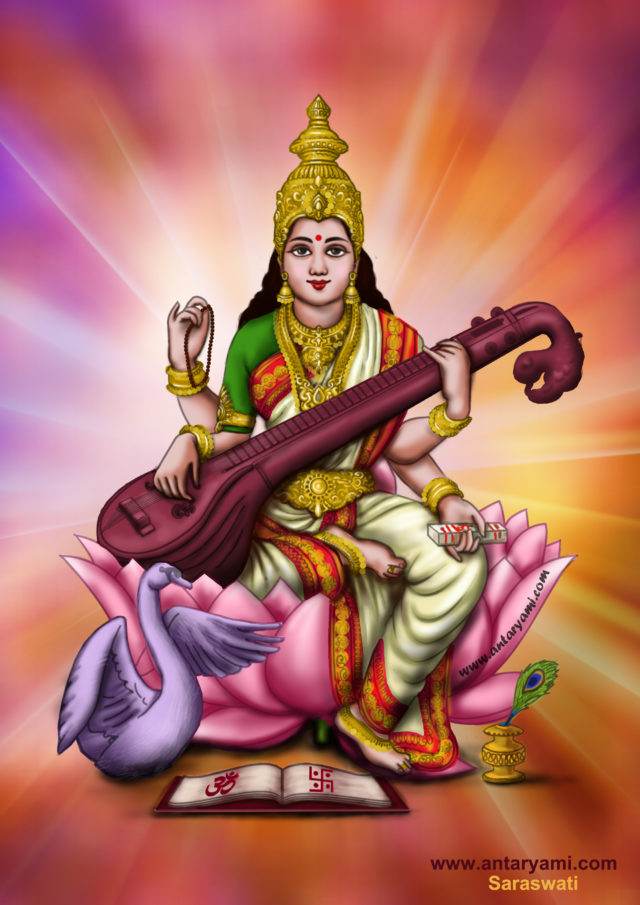
The Vaishnavites pray to Lord Vishnu as the Supreme God. Vishnu is the absolute consciousness from where the seed of consciousness grows (Brahma) to be nurtured into creation through knowledge (Sarawati).

Smartas believe all deities are a reflection of the one God (Brahman) which is closer to the truth than the other three cultures. And this is why there are so many Hindu Gods that are worshipped even in one temple. It is also the reason why Hindus are so tolerant of other people’s religious beliefs.

Hindus understand that the entire pantheon of Gods, together with the demi-gods and asparas – live in each and every soul. They are in our hearts and teach us about our nature. They help us to expand our consciousness on the physical plane so that we can connect with our higher self.

The purpose of the multiplicity of Gods is to invoke the power of the God you need at any given time in your life. So if you do need to change an aspect of your character, pray to Shiva and Shakti and follow the principles that are explained in ancient mythology.

Hinduism is the only religion that does not hide the route to purification and liberation like monotheistic religions, yet is still very much understood by the majority of devotees.

If you are interested learning more about Hinduism read Buddhism alongside it – they are essentially one and the same. Buddhism describes the philosophy with more clarity, but the Gods of Hindu mythology paint a brighter picture that help to explain complicated philosophies.

The Symbolic Meaning of the Hindu Sun God SURYA

0
surya

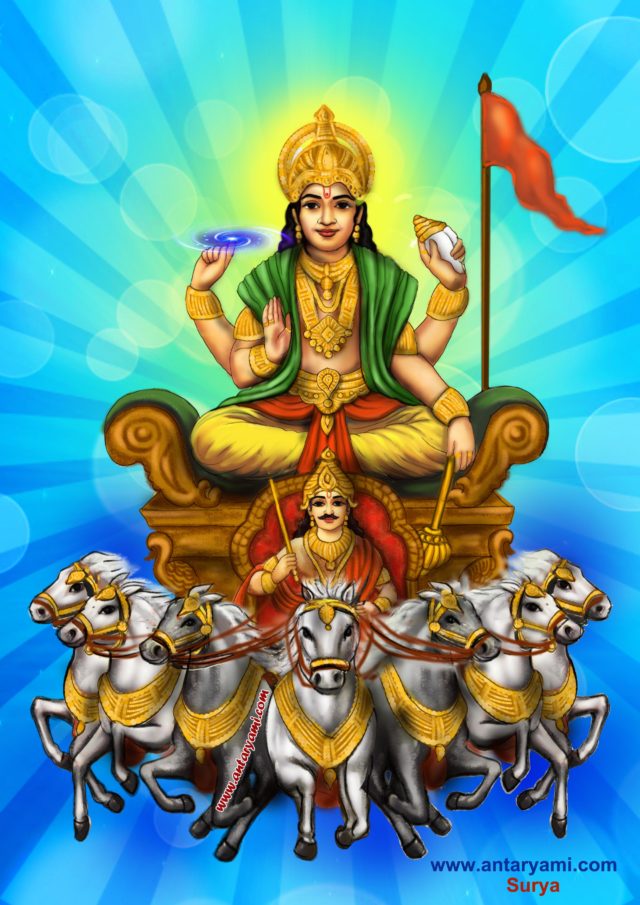
In Hindu religion, gods, demi-gods and asparas all represent an aspect of Universal nature which includes human consciousness. In the case of the Hindu Sun God, Surya we find the force of vital Universal energy that passes through the chakra system and results in karma.

Hindus say pranic energy is the subtle life giving force which allows us to flourish – or suffer. In yogic teaching, breathing through the right nostril is known as Surya Bhedan which increases physical energy and revitalizes the body.

As the Sun God, Surya also revitalizes the body. He is the combination of the 12 Adityas mentioned in the Rig Veda, all of whom have life giving and destructive qualities.

Surya is said to have 108 names which pins him as an Absolute God of existence, although he is only referred to by 23 names in the entire collection of Hindu myths. His other names are merely descriptive taglines for Hindus to relate to in affirmations.

In Hindu art, Surya is typically pictured driving a chariot with 12-wheeled spokes – representing the aspects of our personality in accordance with Vedic astrology – and driven by seven horses, representing the chakras.

If we look more closely and break down the symbolism associated with Surya in Hindu mythology, we can determine that he represents the pingala, the vital energy that presides over our male attributes.

The Sun God in Hindu Mythology

As the ultimate Sun God, Surya represents the vitality and life giving energy that we receive from the sun. This is a common trait of Sun Gods throughout all ancient cultures the world over.

The reason for this is because the symbolic principles of the sun reflect personality traits of man. These are broken down into the 12 prominent character traits we find in astrology.

In Hindu mythology, Surya is associated with the 12 Adityas. There are 12 Gods in the Greek pantheon, Jesus is followed by twelve disciples all of which represent an aspect of mankind that has to be mastered in order to become divine. Not all Christians know this, but Jesus is a Sun God, hence the bright yellow halo.

In Vedic astrology, Surya is given 12 attributes, all of which can be found in the Adityas, but also in the one God – because Hindus believe we are all essentially one consciousness.

This may explain why Surya is represented in Hindu art holding a lotus flower – a symbol of enlightenment and reference to the flower’s ability to blossom above the surface of the water despite the roots bogged in the mud below. At night the lotus closes into a bud and opens into a flower when it feels the light of the sun shining on it.

In ancient myth, Surya is depicted as volatile creature and is worshipped by devas and asuras which reflect his dual nature, positive energy and negative energy.

As the Universal vital energy pingala, Surya is seen as the dynamic force emitted by the flow of pranic energy that passes up the sushumna which wraps around the spine and passes through the chakras.

The female aspect of vital energy is the Ida, and in order to bring these energies into balance through right action, exercise, and correct breathing. Pingala is the right nostril and Ida is the left.

In Hindu myth, Surya’s wife Sanjina cannot come close to her husband because his rays are too bright. In one myth she transforms into a horse and hides in the forest, but Surya finds her and incarnates as a stallion.

Once Surya is reunited with his wife they mate and have a child – the creation of male and female energies. We see this concept of balance and creation highlighted regularly in ancient mythology and pictured by the sun and the moon.

Sun and moon symbolism in ancient myth

Ancient sages used the idea of celestial objects to reflect the inner workings of mankind – hence the hermetic principle “As above so below.” Essentially the macrocosm of the Universe is reflected in the microcosm of man – Mount Meru where the Gods reside.

Together with the 12 sun gods of the Adityas, Surya is also associated with the Navagrahas, the nine cosmic orbs the ancients were aware of; the sun, moon and seven planets.

But essentially the seven planets are the chakras and the sun and moon are the vital Universal energies known as pingala and ida, further known as nadis, which pass through the seven tier chakra system.

In another myth, Sanjana turns herself into a shadow called Chhaya. This legend makes sense when we consider the ancients believed the light of the moon was a reflection of the sun shining through it.

Given the ancient scribes chose Sanjana to become a shadow, we can determine that she represents the moon, thus is the vital female energy ida.

Modern science also gives us an example of light, and energy, passing through objects. When you shine light into a prism, or when reflecting off water, the seven colors of the rainbow appear.

Surya is also pictured with a rainbow over his head in Hindu art. The seven chakras have been given the same colors as the rainbow. Thus we see the idea of sunlight illuminating the planets, and the pranic energy passing through the chakras and leading to conscious awakening.

Chakras are energy centers where vital energy of the subtle body meet with consciousness – the higher Gods of the Hindu Trinity, Brahma, Vishnu and Shiva. In early Hindu myths, Surya was held in the same esteem as the Trimurti, but was given lesser important by the time of the Ramayana.

Hindu yogis continue to practice the ancient custom of practicing yoga and observing the passage of energy through the chakras to ensure they are in balance. Chakras that are closed or out of balance result in physical illness.

Modern science confirms this principle. The second law of dynamics observes that when an isolated system – the human body – is not in balance, the disorder results in disruption – illness, bad luck, struggle. Energy can manifest in many forms.

Hence we see the offspring of Surya, the Ashwin twins, Shani, who judges human behavior and Yama, the God of Death that decides the results of the judgement. This is the principle Hindus recognize as karma.

Who Is The Hindu God, Lord Indra?

0
Indra

Who Is The Hindu God, Lord Indra?

Lord Indra is regarded as one of the most powerful Gods in the ancient Vedic hymns of the Rig Veda. In later myths his supremacy is overshadowed by Vishnu and Shiva. However, Indra is still revered as the King of the Gods and holds an important position in the Hindu pantheon. The only Gods that are above Indra are the Trimurti. But the God of the heavens has Supreme rule over every other God and possesses a powerful weapon known as the vajra.

Indra is the defender of mankind and in Hindu mythology is often found pitted in battle against asuras – demons. On a symbolic level, the demons are the dark passengers of human nature, the habitual thoughts and negative attitudes that lead us astray. Is it not true that we are all possessed by demons? The same is true of the gods, and each represents an aspect of human nature. In essence, mankind is part god and part man, higher consciousness and lower consciousness. Indra represents an aspect of our higher conscious, but as we find in the legends of the warrior king, he sometimes loses control of the heavens and has to ward off demons.

The symbolic meaning of Indra

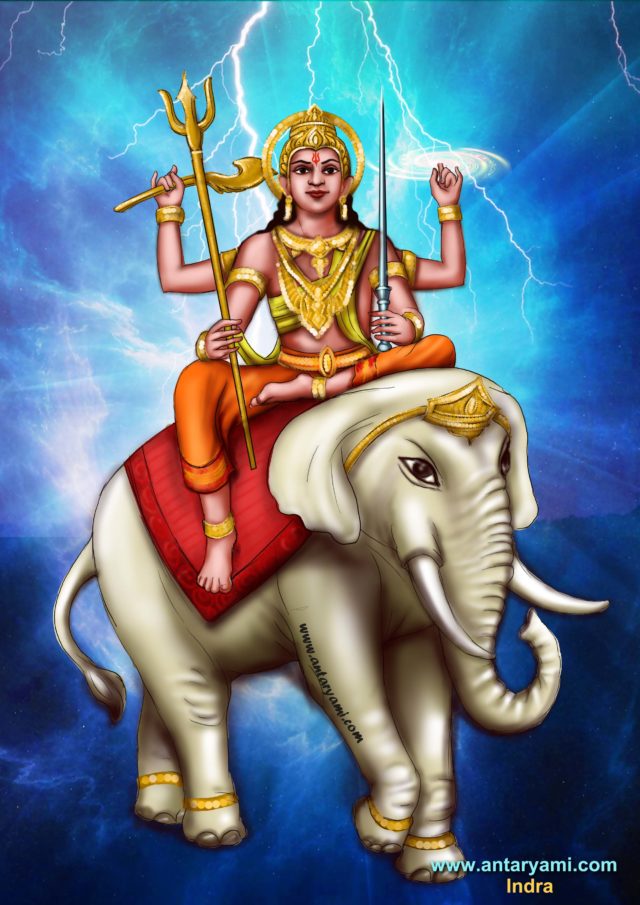
In the earliest myths, Indra was noted as a Sun God which represent the seven chakras. In Hindu art, a rainbow is seen arcing over Indra riding his elephant Airvata. The rainbow also represents the chakra system as they are said to share the same colors. However, he is mostly associated with storms and referred to as the God of thunder and lightning. His most powerful weapon is the thunderbolt, vajra, which he uses to destroy demons. In esoteric symbolism lightning is used to symbolize the connection between the spiritual plane and the physical plane. The thunderbolt is also used by Gods in the myths of other cultures, most notably Zeus in ancient Greece and Jupiter in Roman legends. The Nordic God of thunder, Thor is also seen hurling bolts of lightning from his hammer.

As a storm God, Indra is naturally associated with rain, or more to the point water, a symbol of fertility. All life comes from water. Indra therefore has creative tendencies and brings order to the cosmos, although is also seen asking brahma, the Supreme creator, for help when he realises he is losing the battle. Indra’s assistants are the Rudras, renamed the Maruts in later legends. The Rudras are also storm gods and represent subtle aspects of our destructive and creative qualities. There are 11 Rudras and are said to be among the 33 most important gods mentioned in the Upanishads.

When Indra goes into battle with the demons, he sometimes rides on the back of his steed, the mighty elephant Airavata. When accompanied by Airavata, Indra never loses a battle. The elephant is said to represent, patience, courage and wisdom, the qualities we need to overcome the darker aspects of our personality.

Indra in Hindu myth

There are over 250 hymns dedicated to Indra in the Rig Veda, more than any other god. In this earliest of Sanskrit texts, he is undoubtedly seen as the Supreme deity. It wasn’t until several thousand years later when the Puranas were written that Vishnu was noted as the Supreme God, a title Shiva would later anointed with in the legend of the lingam. Indra’s fall from grace is because of his penchant for drinking soma.

In ancient India, soma was an hallucinogenic plant the ancient used to help them transcend deeper planes of consciousness, much like ayahuasca that is still used by the shamans of South America today. On occasions, Indra would drink soma to give him the strength and courage to fight demons, but also abused it to become intoxicated. It is the lapse of consciousness which leads Indra to become arrogant. But essentially Indra is a noble and peaceful King depicted in his home in the clouds where he lives with his wife Ingrain. Known as Svarga, Indra lives in the highest peak of the heavens which looks down on Mount Meru where the lesser Gods reside. Sorrow, suffering and fear are not permitted in Svarga. Indra and the slaying of the dragon The most notable legend of Indra is the slaying of the demon, Vritra in the Bhagavad Purana. Vritra is a ferocious dragon and swallowed all the water on the earth so the Devas would have to confront him. It was Indra that was responsible for the creation of Vritra. After showing disrespect to Mother Earth and his sage, Brihaspati, the Devas are left without guidance and are subsequently outfought by the asuras.

Brahma tells Indra to seek the help of Vishwarupa, a brahman who is part Asura. Indra does not fully trust Vishwarupa and suspects he is helping his demon brethren. Although Vishwarupa helps the devas to fend of the asura, Indra kills him after overhearing him sending the asuras blessing during his daily prayers. Tvashta, the father of Vishwarupa is enraged by the untimely death of his son and creates the dragon, Vritra to seek revenge. During the battle, Indra is swallowed by the monster, but whilst in the gut of the beast uses his vajra to slice open his belly and release the water back into the earth. A later telling of this story in the Mahabharata sees Indra chased by a female goddess called Brahminicide. The god is forced to admit his sins for killing the Brahman, Vishwarupa.

This is the equivalent of giving into our ego, admitting we are wrong and atoning for our errors. Indra then becomes and ascetic to learn wisdom and fulfil his duty as King of the Gods. He learns the qualities required on the material plane that help us connect with the spirit world – our true self. So in conclusion, Indra is the over-confident aspect of human nature that becomes arrogance. By humbly accepting our faults, abandoning ego and self-importance we are able to improve ourselves as human beings and better our relationships.

What Do Lakshmi Represent In Hindu Mythology?

0
Lakshmi

The symbolic meaning of Lakshmi
In terms of our relationship with our higher conscious self and how it impacts on our physical experience, the symbolic meaning of Vishnu is easier to understand when you consider his consort, Lakshmi. When you study ancient mythology, especially Hinduism, you will notice each of the Gods has a consort, or shadow reflection of themselves. The wife’s of the Gods are sometimes projected as the feminine aspect of ourselves and sometimes the reflection of their counterpart. For example, the Vishnu Purana explains the role of Lakshmi are the manifestations of Vishnu in the many forms he takes; “When Vishnu is meaning, she is speech; Hari is polity, she is prudence; Vishnu is understanding, she is intellect, he is righteousness, she is devotion.”
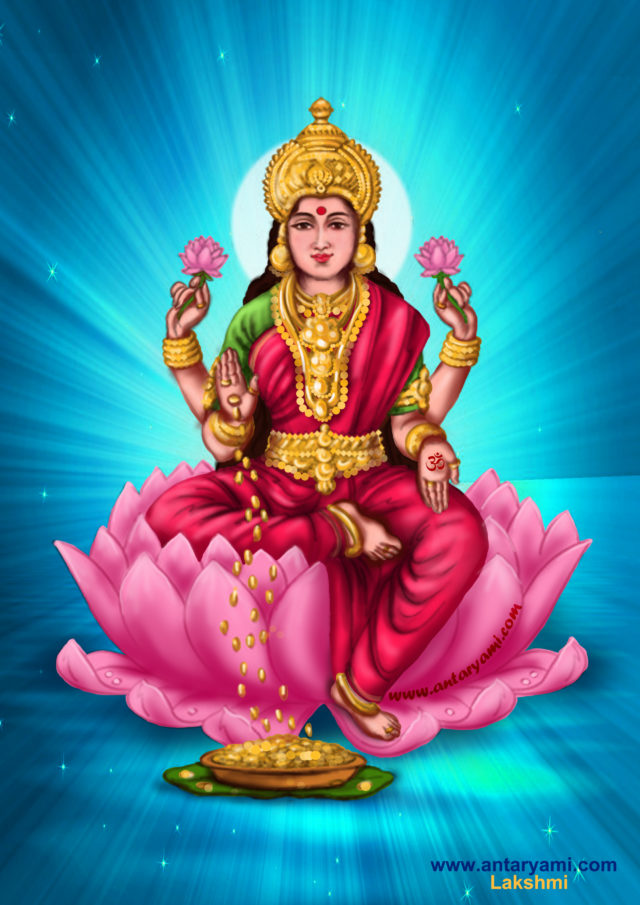
In Hindu myth, Lakshmi is said to appear from the ‘churning of the milky ocean’ which represents the struggle between good and evil – or more precisely the higher conscious self, and the habitual mind of the subconscious. So whereas Vishnu is absolute consciousness, his consort Lakshmi represents our physical well-being, thus she is known as the goddess of wealth and prosperity. As we have already established, consciousness manifests as reality. Lakshmi is the physical manifestation of consciousness. Given Lakshmi appears seated on a lotus flower, she represents that we have an innate ability to become enlightened – this is what the lotus flower symbolises in several ancient cultures including ancient Egypt and Buddhism. Hindus recognize Lakshmi as the Mother Goddess and Goddess of Wealth, the nurturing side of our character that we need to adopt to bring whatever it is we focus on into fruition. In essence, Lakshmi nurtures consciousness which we see in Hindu mythology by her massaging Vishnu’s feet.

The symbols of Vishnu and Lakshmi
In Hindu art, Vishnu and Lakshmi are presented with four arms which represent prosperity, perfection, Dharma, and the freedom from emotional bondage. The devoted couple are often pictured laying on a serpent floating on a peaceful lake which represents the highest wisdom you can achieve by having a still and blissful mind. Like all the Gods and consorts of the Trimurti, Lakshmi and Vishnu are found sitting on a lotus flower, although it is usually hanging from Vishnu’s lower left hand. The lotus flower symbolically represents being in a state of enlightenment, or as Hindu’s call it Moksha, meaning to be liberated from material and emotional bondage.
In his upper right hand, Vishnu holds a discus which by some accounts represents the “spinning wheel of time.” But Vishnu uses the disk to defeat demons so from a psychological viewpoint, the disk represents the purity of mind. In the upper left hand, is a conch shell which is the symbol of creation in ancient symbolism. When the Universe was created it made a sound, represented by the om symbol. In ancient times the conch was used to awaken people in the morning, thus is used as a sound of awakening. In his lower right hand, Vishnu holds a Mace which represents the destructive nature of consciousness manifesting into reality. The Mace, known as the Kaumodaki, is said to represent the punishment handed out by Vishnu when we fail to follow Dharma which prevents our consciousness from evolving.

What Does Vishnu Represent In Hindu Mythology

0
vishnu

Vishnu is one of the Supreme Gods of the Hindu pantheon and together with his consort Lakshmi is widely worshipped by Hindus. Officially known as the preserver, Vishnu is recognised as the God that pervades and sustains the Universe, but his true symbolic meaning drills down much deeper into the human psyche. In Hindu myth, Vishnu takes on many forms and the roles he assumes can be somewhat confusing when attempting to interpret his true meaning as a personified God.
But like all Hindu Gods, Vishnu is symbolic of consciousness and aspects of human nature. As a member of the Hindu Trinity alongside Brahma and Shiva, Vishnu is recognised as a Supreme deity. In Vedic literature he is also known as Hari and Lord Narayana, both of whom we see represented as Absolute Truth. Essentially Vishnu represents absolute consciousness. It is for this reason that Hindus consider Vishnu as the protector of the Universe. In Hindu myth, Brahma is born from the navel of Vishnu and goes on to create the world and everything in it. Brahma is thus the creative expression of absolute consciousness – the source. Vishnu in Hindu mythology The Rig Veda tells us that “Vishnu is the most ancient of all, yet also the most recent. Nothing and no one createsVishnu, yet Vishnu creates everyone and everything.” The meaning here is very subtle, but when we consider the incarnations of Vishnu throughout Hindu mythology, we discover the pattern of evolution from fish to man.
Beginning with the fish, Matsya to Buddha, Vishnu has been reincarnated nine times. His next reincarnation is said to be Kalki, the tenth and final incarnation of man. Hindus believe we are living in the time when Kalki is due to make an appearance. This merely means that future generations will be born more spiritually aware than previous generations. We find in Hindu mythology that Vishnu has taken the form of:
– a fish
– a reptile
– a pig
– half man, half lion
– a dwarf
– a man with an axe
– Rama, a moral man
– Krishna, a philosophical man
– Buddha, an enlightened man
We can therefore see the theory of evolution unfolding in ancient literature, only the sanskrit writings go one step further to explain that all life begins with consciousness and over time continues to evolve on to the next stage. The same can be said for human consciousness within our lifetime. It is fair to say that many people in the modern world are the man with the axe, workers. A good percentage of workers also have the moral qualities of Rama. There are fewer men that are philosophical and fewer still that are enlightened. Ayurvedic yogis describe consciousness as awareness or being present in the moment. It is the significant moment when we reach an understanding. But it depends what you do with the knowledge that determines the outcome of your conscious evolution. This is why ancient sages described Vishnu as the preserver. As we learn things in life we live by them, and it is our moral duty to do the right thing. Hindus call this Dharma. When you uphold your Dharma you invoke the power of Vishnu and can consciously evolve. Furthermore, by becoming more consciously aware of your true self, the absolute consciousness which Vishnu represents, you dissolve your ego and develop peace of mind whereby you can live in bliss and happiness.