














Home Blog Page 38

Meditation Can Bring in Welcome Changes to your Brain
0
photo-1469430312744-da82019cc8ae

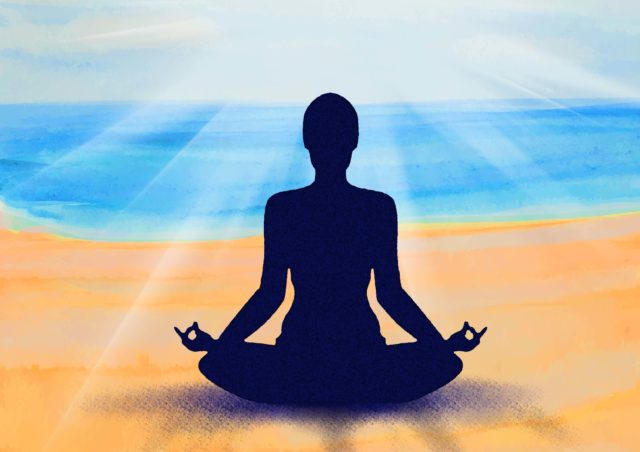
Meditation has more than often been linked to mental and spiritual well being according to most of the research and data available. Meditation can provide you with a host of neurological benefits and improve your cognitive abilities by enhancing brain function. Let’s look at some ways in which it uplifts your mind body and soul.

Here is how meditation improves your brain and cognitive abilities

#1 It slows the process of brain aging
That’s right! The next time you are on a yoga regime, get ready to feel mentally younger. A study from UCLA found out that people who were long-term meditators had better preserved brains than non-meditators.

Participants with over 20 years experience of meditation had relatively higher grey matter volume than those with less experience or none at all. Such effects were not seen in specific areas but across the brain according to study author Florian Kurth.

#2 It increases your focus and keeps your thoughts from wandering around

That’s right, meditation shuns away the idle thoughts of the inactive mind. The Default Mode Network (DMN), which is the brain network responsible for mind-wandering thoughts, experiences a power down each time you meditate.

The thoughts associated with DMN are generally random thoughts and ruminations where one can worry about the past or future. Therefore, many people want to dial it down. So the next time you are worried about your marriage next year, try some yoga instead!

#3 It can give antidepressants a run for the money

That’s right folks! if you are going through some tough, anxious times then go for meditation not medicine!

Last year, a review study conducted at Johns Hopkins analyzed the relationship between meditation and its power to reduce symptoms of depression. As it turns out, the effects were same as prescription antidepressants that are given to patients.

But remember that this not mean that you will just to do 4-5 poses a day and you’re set. Meditation is an active training of the mind to increase awareness and it requires patience. It can very well help you in toning down the symptoms but you also need to put in maximum effort!

#4 Meditation makes your brain bigger, better and brighter

Don’t trust me? Here is what research says:

• Only after 8 weeks of stress-reduction based meditation (MBSR), the cortical thickness of the hippocampus increases. This hippocampus controls learning and memory.
• Brain Cell Volume in the Amygdala decreases. It is Amygdala that is responsible for fear, anxiety and stress.
• Meditation not only changes the brain but also the subjective perception or the way we see things.

Follow-up studies also found that meditation leads to an overall improvement in how people feel. Improves moods, controlled rage and enhanced arousal were some of the results.

#5 It amplifies focus and attention

If you were thinking only kids find it difficult to concentrate, you’re wrong. Attention Deficit Disorder (ADD) affects millions of grown-ups across the world.

A recent study found out that just after a couple of weeks of meditation training, participants had improved memory and attention span. The participants were made to take the reasoning section of the GRE and performed better than before the practice began!

#6 Say goodbye to Rehab: Meditation is the answer for addiction

Given the enhanced self-control meditation fosters in practitioners, meditation can be effective in helping people recover from alcohol addiction, substance abuse problems, smoking and what not.

In a study at the American Lung Association’s Freedom from Smoking (FFS) program, it was found that meditators were more likely to quit smoking at the end of training

It has been proven more than often that regular meditation helps phase out the state of craving for anything. Therefore, slowly and steadily it helps the practitioner to move away from the addiction completely.
There is a lot of evidence to support the fact the meditation does improve brain function and cognitive abilities. Corporations like Google are increasingly accommodating meditation regimes in their HR infrastructure.

If you have good instructor, then meditation can be very beneficial for you. The best time is to practice is in the morning at dawn or in the evening at dusk.

It is time we started looking towards the ancients to find some relief and identity for ourselves in this heavily competitive universe we have created for us. Find the time.
What Does Lord Shiva Represent in Hindu Myth

0
shiva


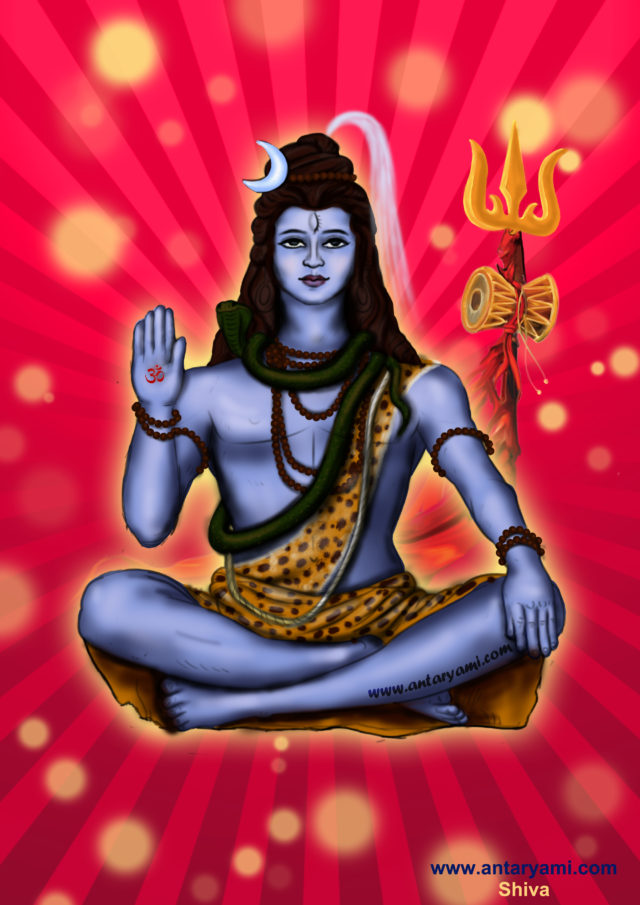
Given the tender nature of Hindus, it is somewhat surprising that one of the most popular gods is known as “the destroyer.” But Lord Shiva’s appetite for destruction comes in the form of destroying one’s ego.

Lord Shiva proved himself to be the most powerful god in the Hindu pantheon. We find this concept in the story of the Shiva Lingam which portray the god as having the ability to transcend time and space and essentially live forever.

In one ancient myth, the three gods of the Trimurti were arguing over who is the most powerful. To prove he was the highest authority, Shiva transforms into a shaft of bright light that embraces the Universe.

The god challenges Vishnu and Brahma to find the end of the lingham. Neither God succeeded, but Brahma, wanting to be considered the most Supreme God, lied and said he had found the end.

Angered by Brahma’s deceit, Shiva burns his fifth head, the one that had formed on the top of his head. The crown of the head is where we connect with our true self, the fifth element, sometimes described as our spirit. Our soul.

In Hindu myth, Shiva is an ascetic and is often found alone in his cave, meditating. In these moments, Hindu art projects the concept of tranquillity and a mind that is at peace.

It seems absurd that such a relaxed god can be angered so easily and associated destruction. But Shiva is consciousness and our higher self – the “super-ego” – is maddened by the ego, the conscious mind.

The conscious mind often succumbs to habits that are created by desire. Desire comes from our emotions and distracts our thoughts. Thoughts and emotions are represented by the androgynous form of Brahma and his female aspect, Saraswati.

This is why we often see Shiva arguing with Brahma and getting angry with him. Shiva’s ability to destroy represents the destruction of our ego. We sometimes need to lose the ego.

The power of Shiva

Lord Shiva may be unpredictable, but whatever he dissolves is recreated with the help of his consort, Parvati, goddess of love and fertility. Together, Shiva and Parvati represent ability to destroy ego and develop a higher state of consciousness.

Hindus evoke the essence of Shiva when they want to change something about their actions. Our actions are driven by thoughts and emotions, and by overcoming habitual acts, you can nurture in new patterns of behaviour.

Thus the principle lesson of Shiva is that by connecting with our higher conscious and dissolving character traits, belief systems and actions that no longer serve us, we experience calmer states of mind.

The concept of personal transformation is identified with the idea of death and rebirth – resurrection. This idea is emphasised in the story of how Shiva’s son, Ganesh came to acquire an elephants head.

Parvati had a guard whom she instructed to refuse access to everyone that asked to enter into her private chambers. When he let Lord Shiva enter she dismisses the guard.

Needing a guard she can trust with all her heart and soul, she gives birth to a son. Ganesh.

Reliable and faithful, Ganesh refuses Shiva entry into his wife’s chambers. This angers the god and he kills Ganesh by setting his head on fire with his third eye.

Upset by the actions of her husband, Parvati orders Shiva to resurrect her son. Shiva obliged, but can only find an elephant’s head.

Ganesh is known as the remover of obstacles, but it often goes unnoticed that he also places obstacles. As an extension of the aspects personified in Parvati and Shiva, Ganesh represents those times when things either go smoothly, or when we have a bad day.

The lessons of Shiva and Parvati in Hindu Myth

The lessons we learn from the stories of Shiva in Hindu myth help us to understand why Shiva is the most powerful among the Supreme Gods.

One part of Shiva symbolises our need to give something up. We see this concept demonstrated in the story of Shiva’s marriage to Parvati – a reincarnation of the Lord’s first wife, Shakti.

When Shakti killed herself in the fire of Yagna Shiva retires to a cave to be alone. With Shakti gone, there is nothing in the world he wants.

Shiva becomes a recluse and does not even have the energy to help the gods save the Universe when they are attacked by demons. An oracle informs the worried gods that only a son of Shiva could defeat the demons.

But for that, Shiva needed a wife. So Shakti, who represents energy, reincarnates herself as Parvati. Depicted with dark skin, Parvati represents the dark side of our nature, the negative energy and Shiva rejects her.

Determined to win over Shiva’s love, Parvati commits to equalling the powers of Shiva and dedicated herself to meditating and requiring knowledge. When she becomes as powerful as Shiva, she turns into a golden beauty and the God recognises her as his equal.

Together, Shiva and Shakti represent universal energy. In ancient symbolism, this concept is represented by Ida and Pingala.

What do Shiva’s symbols mean?

Shiva is typically pictured lying on a serpent, which represents consciousness, both the sub-conscious mind and the higher-self. The serpent is Shiva’s bed, indicating the Lord is at peace and is master over his sub-conscious.

The other main characteristics of Shiva is the third eye in the middle of his forehead and the trident, both of which he uses to destroy anything that angers him.

The ajna is also centred on the forehead. Hindus also call this point the third eye chakra. This is our mind’s eye, the ability to visualise in our minds. During meditation it is possible to destroy aspects of yourself that no longer serve you.

Modern science is beginning to discover the “phenomena” of neuroplasticity, the ability to change the course of our neurons and change our patterns of thinking.

Our mind is more powerful than we believe. Although it may be difficult at first, it is possible for us to dissolves character trait, attitudes, bad habits and addictions we do not need.

The necklace of skulls that hangs around Shiva’s neck symbolises this philosophy, once again projecting the idea of death and rebirth that we find throughout ancient mythology all over the world.

The Symbolic Meaning of Brahma in Hindu Myth

0
Brahma

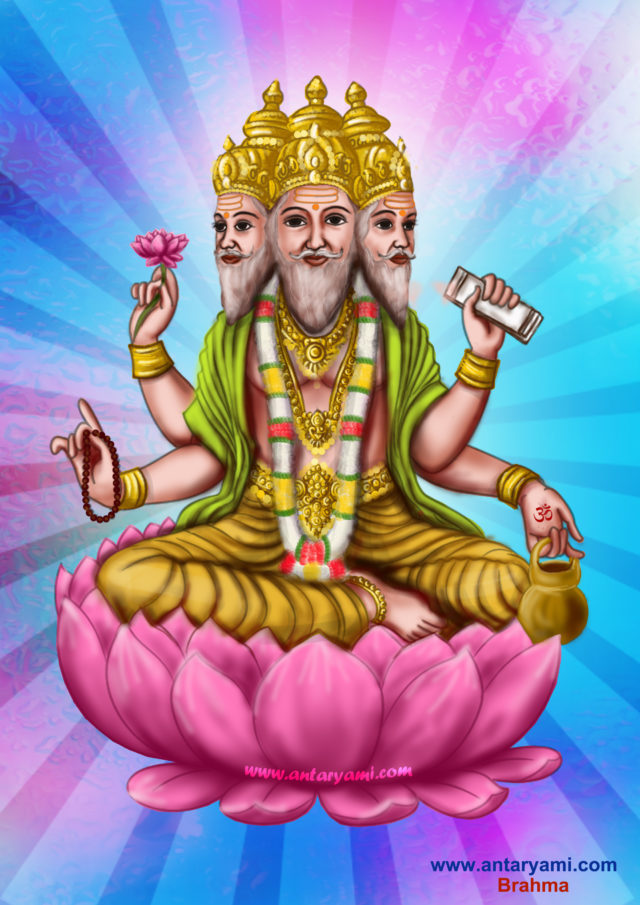
Although Lord Brahma is a member of the Hindu Trinity, he is not widely worshipped and there are no festivals or rituals held in his honor. Curiously, there are only three temples dedicated to him in India.

Yet Brahma is the Creator God of Hindu mythology, and as a member of the Trimurti is considered a Supreme Deity. So why is Brahma not revered by Hindus with the same passion and fervor as Vishnu and Shiva?

The official reason can be found in a Hindu myth. After angering Shiva, “the destroyer” Shiva curses Brahma and tells him he will never be worshipped by mankind.

However, this is not the true reason – the proposition that I am making here. Perhaps it is speculation. In ancient symbolism, Brahma represents the mind, and because the mind is unpredictable and can deceive us, Brahma is not worthy of veneration.

Having said that, the enlightened men and women among us that have learned to master their minds, have every reason to worship Brahma.

As the creator God, Brahma is described as the “Universal Mind”, thus in ancient symbolism represents our conscious thoughts. He is mentioned in myth as being born from the cosmic egg, whilst later he emerges from Vishnu’s navel on a lotus flower.

The cosmic egg is the Universe. Vishnu represents absolute consciousness and the ultimate laws of existence. As I will demonstrate later in this article, Brahma essentially represents our conscious thoughts and the nature of the human mind. His consort Saraswati represents our emotions.

In the myths of Brahma and the other members of the Trimurti, you will find in ancient Hindu wisdom, the modern concept that we have a higher consciousness and by tapping into it we can overcome attachment to desires that ultimately destroy the connection we have with our true self.

Brahma and Saraswati

Having emerged from Vishnu’s navel, Brahma creates the world, but finds he is alone, so creates a female consort, Saraswati (although she is called many names) from his head.

Readers that are familiar with Greek and Roman mythology will be familiar with this story. Zeus gives birth to his “daughter” Hera, who later becomes his wife.

The story told in the ancient Hindu literature of the Matsya-Purana, explains that the Creator God splits in two whilst meditating and produces the female dimension of himself.

As the daughter, Saraswati represents the untamed emotions of a child and distracts Brahma with her beauty, representing the essence of desire. It is times like this when the ego takes over and the habitual mind kicks into auto-pilot.

The Creator God becomes infatuated by Saraswati, but she spurns his advances and runs away. Brahma sprouts five heads in search of his desire and finally finds her. The five heads represent our emotions which dictate the desires we have.

Emotions provoke desire and attachment which become a distraction. We lose our sense of higher consciousness and become controlled by the habitual mind of the material world.

In the Puranas, Brahma’s fascination with Sarswati angers Shiva, who burns off one of his heads with a fiery third eye. Shiva is known as the destroyer of ego and burns away our desires and attachments.

Brahmas misdeeds are essentially a reminder that we can sometimes allow our emotions to run away from us. When impulsions overcome the mind, we have crazy thoughts and act out of desperation. Shiva is a karmic reminder of the destruction that follows.

The symbolic meaning of Saraswati in Hindu myth

The name Saraswati comes from the root word “Swa” in ancient Sanskrit, meaning essence or self. Assigned as the goddess of knowledge, learning and creativity, she is a reminder that we need to acquire skills and information before we act.

She also represents the vibrations of the Universe, seen by her playing musical instruments. The instruments make sound, and the sound – symbolized by Aum – is the point of creation in Hindu mythology.

The goddess is often pictured with a peacock in Hindu art. The peacock represents resurrection, but because of the bird’s ability to kill and eat snakes, represents our innate sense to overcome the demons of our habitual mind.

Thus the vibrations of creation that Saraswati represents, “resurrect” on the material plane as manifested reality. This is what Hindus and Buddhists call karma.

When Saraswati eventually yields to Brahma, they become one. Together the couple represents the balance of mind and emotions. By controlling the emotions with the mind, rather than mind with emotions, order is restored.

Here, ancient myths reveal that the ego must overcome temptation and balance the heart and mind with analytical thought and nurturing emotions. Essentially, we have to focus on doing the right thing in every moment.

The lessons we can extract from the stories of Brahma and Saraswati is that by being consciously aware of your emotions and taking control of perpetual yearnings, you will find peace of mind and attract more harmony in your life.

The fate of Brahma

It is also said in Hindu myth that Brahma goes to sleep for 4.32 billion years, which represents one day in cosmic terms. In Gematria, 4.32 billion years is nine (4+3+2) which symbolizes absolute consciousness, personified in Hindu mythology by Vishnu.

When Brahma consciousness returns to absolute consciousness – which we do in our sleep – boons or curses are handed out depending on whether we learned our lesson and acted accordingly.

Psychoanalysts believe that during sleep, our mind, and our physical bodies, explore the spiritual worlds of the astral planes. It is believed there are nine levels, the final destination being absolute consciousness.

Whilst our sub-conscious is in the astral planes, our future is being created based on our vibrational energies. If we have acted negatively, we emit low vibrations and only reach the lowest levels of consciousness where demons lurk.

This is when bad fortunes occur.

Whilst Brahma sleeps, the world – you – are consumed by fire. Order is only restored when he awakes. Thus the fire forges a new creation and when the metal cools, it hardens in reality. We call it fate.

The Art of Yoga

0
yoga-4


As a teacher of meditation, I am often faced with many questions and misconceptions about what meditation is. Although many people have an awareness of meditation, and many people now do understand it, if someone is new or if I am working with a group in a workplace for example, people will come along just to see what its all about.

Some people think it will be incense and chanting, others think its a little hippy dippy and some simply think its a little weird. Either way, people are interested and I like to start off all sessions with a little briefing, just to put people at ease.

The Engine Metaphor…

Once people are sitting and are feeling comfortable, I like to explain the following metaphor;

“Imagine your mind is like a car, and each morning as soon as you wake up, you switch on the engine straight away and just leaving it running the whole day.

Now imagine the engine is your stream of thought… you switch it on, and then you engage with it straight away. You follow the sounds, noises and vibrations - which are the
equivalent to all the thoughts streaming through your mind.

Now because you are so used to tuning in to the engine (or your thoughts) you don’t stop to question their validity… you just listen to the drum of your mind and you stay tuned in all day…usually until you fall asleep.

Just like a car engine is part of a system, so is your mind…

And just like you can turn a car on a let the engine run without engaging with it constantly … you can do this with your mind…

You are the driver of your mind - not the passenger…

The point therefore of meditation is to tune out of the engine noises and enter the quiet zone…

You will still hear the engine in the background, but the difference is… you are not solely listening to the engine… you can choose where to place your attention”

Many people find this quite surprising at first, its a revelation to understand that our thoughts are automatic, and its a different perspective entirely to grasp the concept that we can tune out of the thoughts.

By focussing our attention away from our thoughts, we immediately take ourselves out of the chaos of life and allow peace and serenity to enter our lives.

Is Meditation For Me?

Meditation is simply a way in which anyone can step out of their current mind identified state and enter a place of calm. Not everyone finds the lotus position comfortable, not everyone likes to sit for an hour at a time, and not everyone likes to sing, chant or sit within a group of people. There is never any right or wrong way to meditate, the true art of meditation is find your own unique way that suits you.

When I work with a person I find out what they they like to do, how they feel in daily life, and importantly, what they want to achieve in life. Meditation is not simply about following a structure, its about going within yourself and reaching for something deep inside of you that you already know. The best way to find out what works best for you therefore, is to try a few different things and see what makes you feel good…

“A true sign that you are in a meditative state is when you feel good about what you are doing and feel good about life in general…”

So where do you start?

Below I have listed a few different options for meditation, and I would always say to
people, try this out and see how you feel…

Types of Meditation

Transcendental - this form of meditation became very popular in the 1960’s and is essentially a mantra based meditation. During a transcendental meditation session, you will repeat a word or phrase (a mantra) and focus your attention on this. The mantra is usually a Hindu deity, and the aim is to meditate twice a day to achieve peace in mind, body and spirit.

Walking - this is a traditional buddhist meditation in which you literally focus your entire attention on each step you are taking in that moment. By focussing on each step, your mind becomes clearer and allows more space to be created for positive intentions, as opposed to worrying about the past and future.

Presence / Mindfulness - this is where your focus becomes entirely on the present moment. This exists outside of time, as you will focus on the fact that the past no longer exists, therefore cannot affect the present moment, and the future is yet to happen, therefore does not affect the present moment.

Hindu (Vedic or Yoga) - again this is a mantra based meditation. This is where the famous OM meditations come from, and are practiced to achieve a state of total peace and oneness. The word OM is consider to be the sound of all creation in many religions. In Hinduism it refers to all that is and Brahman - the ultimate truth of reality. In Christian literature the beginning of all creation was ‘the word’ and many believe in spiritual truth, that the word was Om.

Zen - this meditation is one where you will sit in a position such as the lotus position and focus entirely on your breathing and the present moment. Its often referred to as ‘effortless effort’ in that you become calm and serene as you focus on the breath entering in and out of the body and use the sounds around you to enter a zen state.

Vipassana - this is very similar to mindfulness / presence based meditations in that you bring your focus to the present moment. The aim here is to work with the breath primarily, by completely placing all of your attention on breathing, noticing the life force in and around the body. This is sometimes offered as part of silent retreats, where participants remain silent throughout the retreat, allowing people to experience total peace and quiet.

Guided - these are where a teacher will talk you through the meditation. This is a perfect way for people new to meditation to explore different styles and in due course, find their preference. This usually begins with a teacher leading you through a series of breathing exercises, and then maybe focussing on a specific topic such as ‘letting go of anger’, ‘exploring nature’ and focussing on the present moment.

Music - there are literally hundreds of types of music based meditation, from shamanic drumming, gong baths, binaural beats, classical music and so on. Music based meditations are beautiful as we focus our attention on the music, the beat and the vibrations entering our bodies. Many people love music based mediations as they can literally get lost in the music and enter perfect presence from here.

Feelings vs Thoughts - Life Hack

A very very quick way to evaluate what works for you is to completely bypass anyone else’s opinion and thoughts, or any judgements you may have about a practice and go straight to the feeling.

“One feeling is the equivalent to literally hundreds and thousands of thoughts, all of which can then tempt you in to the mind again…

If you can focus on the feeling rather than the thoughts, this is the truest reflection that something is or isn't working for you”

For example…

If someone is trying transcendental meditation and they start to feel uncomfortable or wanting the time to pass quickly to ‘get it over with’, and this produces a stress like feeling… this is an indication that this maybe isn't the best way for you.

That is not to say you are doing it ‘wrong’, its more that it doesn't suit you right now. So then it might be time to try something else.

There will be a starting point for you, and you will find your way in to meditation. The art therefore is to listen to what your feelings are telling you and always head towards what makes you feel good.

Hindu Philosophy, Mythology and Symbolism

0
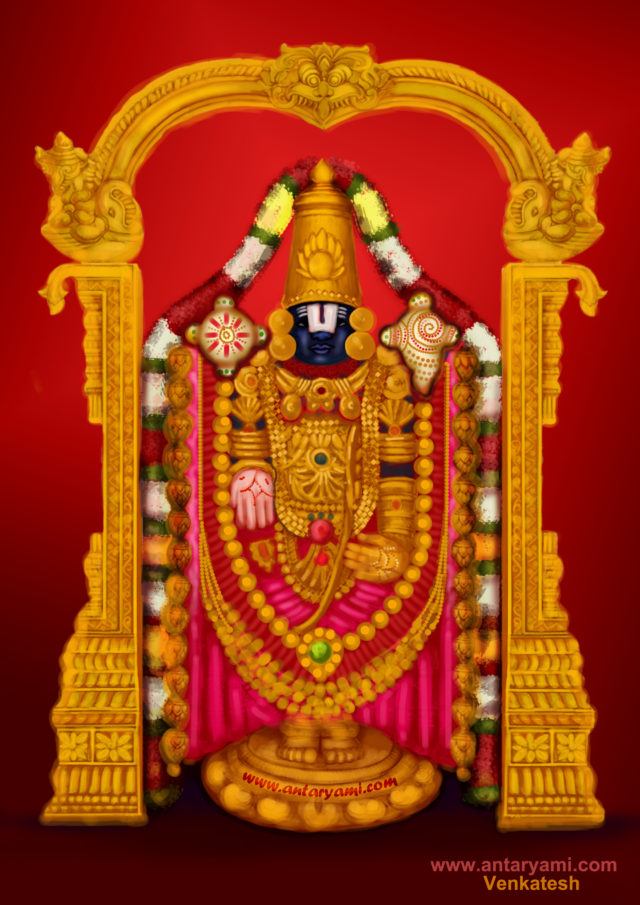
Lord-Venkateshwara

Many years ago I dated a girl from Nepal. She told me Hinduism was not a religion or a philosophy, but a way of life. Rich in meaning, I have been enamoured by the Hindu lifestyle ever since.

After years of studying Hindu myth and philosophy, I came to realise there are underlying meanings to the epic tales. The gods – devas, devis and demons – are personifications of ourselves and through dedication and meditation the lessons within these ancient texts can help us find peace of mind.

There is a mysterious essence about Hinduism that is shared by many other religions in the world, yet the difference is there appears to be few arguments about what the stories told in Hindu myth mean. However, that does not mean that modern interpretations are entirely accurate.

Even so, unlike other religions which cause terrible conflicts and rivalry, Hindus are open-minded and respect the views and opinions of others. Hindus understand that everybody follows there own path and subsequently tolerate all other religions.

It is quite clear in my mind that the Hindu belief is right. The objective of organised religion throughout the world causes war and debate that is destructive, misleading and distracting.

When you study ancient texts you will find they have symbolic meaning embedded into them. And they are all teaching the same lessons. Myths are essentially puzzles initiates have to solve for themselves. And because we all have different experiences in life we all learn in different ways.

Everybody has their own path. And the lessons to be learned along the way are buried deep within the ancient symbolism.

A brief history of Hinduism

A shroud hangs over the origins of Hinduism. Scholars are not certain of the exact dates the practice began and are divided in their opinions as to how it started in the first place.

Believed to date back to around 2000 BCE, Hinduism is called the oldest “religion” although traditions and philosophies found in Hinduism existed in earlier civilisations such as Egypt and Mesopotamia. (modern day Iran and Iraq).

What we do know is that Hinduism began in India and spread throughout the Indo-China region. Some theories imply it was forged from a combination of the Zoroastrian philosophies of the Sumerians and the ancient Vedic traditions that already existed in India.

One of the leading debates amongst scholars is the Aryan Invasion that settled in northern India having travelled from Asia Minor which is modern day Turkey. However, the Aryan description of blond hair and blue eyes is more fitting of ancient Nordic races. Furthermore, ancient Sanskrit bears a close resemblance with many modern European languages.

In 1921, archaeologists discovered an ancient settlement along the dried up Saraswati river basin which flowed across north-west India and into Pakistan. It is believed that a group of peoples known as the Harappan civilisation lived there 9000 years ago.

Small seals have been found with images of the Hindu God, Shiva, said to be the most powerful of the Hindu pantheon. The history of Hinduism therefore probably dates back many years than scholars give it credit for.

Of course, the name given to the practice was probably different back then, but there is a strong possibility the underlying themes, symbolism and lessons share a close resemblance. Vedic texts were almost certainly the forerunner of what today is known as Hinduism.

Hindu mythology and symbolism

Hindu teachings come from ancient Sanskrit texts, many of which have not been deciphered. The oldest texts are the Rig Vedas written about 3500 years ago.

The vedas, as they are more commonly known, were later followed by the Puranas, the sacred laws, the epics, the Vedantas and the Yogas. The stories told in these ancient books eulogise multiple Gods – said to be 330 million deities, although most are reincarnations of earlier characters.

In the fourth chapter of the Rig Vedas, the Brihadaranyka, Yajnavalkya identifies 33 principle Gods which he then attests is actually one God. And that God is you – or rather your higher self.

In gematria – an ancient form of mathematics that adds up numbers until the figure is reduced to a single digit – 330, 000,000 equals 33. Repeating numbers, 11,22, 33 etc and 111, 222, 333 and so on are master numbers and not broken down further.

In ancient symbolism, the number 33 represents enlightened beings that have mastered their emotions and have peace of mind. Christians will be aware that Jesus began his ministry at the age of 29 (2+9=11) and died at the age of 33. Christians are confused why Jesus is “God and man.” In essence, Christ is the God IN man.

The correlation between Buddhism, Judaism and Catholicism can all be related to Hinduism which in all likelihood was designed from earlier traditions. It’s worth mentioning that Islam bears a close resemblance to Judeo-Christianity. This all modern world religions have roots in ancient wisdom.

Hindu mythology influenced the teachings of Prince Gautama Siddhartha, the historical Buddha, the father of modern day Buddhism. History attests that Gautama Buddha was dissatisfied with the corrupt teachings of corrupt authorities and sought to find his own Truth.

Siddhartha was 29 (11) when he began his life as an ascetic and reached enlightenment six years later at the age of 35 (3+5=8). In Hebrew, the number of God is 26 (2+6=8). So God is recognised in the number eight and when Siddhartha reached enlightenment he became a God IN man.

Buddha or Bodhi, comes from an ancient Sanskrit word to mean “enlightened one.” Many “Buddhas” existed before Siddhartha Gautama. In ancient India they were called yogis. Today, we hear yogis being described as “people who are proficient in yoga.”

Whilst this statement is true, the ancient practice of yoga involved much more than the balancing exercises we perform today. The point of yoga is to sharpen the mind’s ability to concentrate and train initiates to practice meditation effectively.

It is through meditation – or if you prefer contemplation – that you acquire self-knowledge. You become enlightened and the master of your thoughts, emotions and actions. You become a Buddha. God in man.

In the famous Hindu epic the “Bhagavad Gita,” Lord Krishna describes yogis having:

“Fearlessness, purity of heart, perseverance in acquiring wisdom.”

This is the way of life initiates of Hinduism must learn to reach self-enlightenment.

Hindu Gods

0
Ganesha

The Principle Gods of The Hindu Pantheon

The Hindu pantheon is crowded with multiple Gods – 330 million is the official count. However, this figure is grossly misleading. The majority of Hindu Gods are actually avatars of earlier Gods.

In the third chapter of the Rig Veda, the character, Yajnavalkya, explains there are 33 important Gods. Throughout the course of the conversation he says there is only one God. All the other Gods are merely aspects of the Absolute God.

And that Absolute God is you.

The Gods (devas) are fragments of your higher self. The demons (asparas) are your lower consciousness. Devas and Asparas are manifestations of how you think, feel and behave. And those aspects of human nature are symbolically personified within the millions of Gods that have featured in Hindu myth over thousands of years.

In this blog we focus on the principle Gods that are still worshipped by Hindus throughout the world. The myths in which they feature have life lessons that are as prevalent today as they were thousands of years ago.

We also retell Hindu myths and discuss the meanings of esoteric symbolism. Knowing how to decipher the symbolism in ancient myths gives you a profound insight into the underlying meaning of the stories.

But for now, we would like to present a brief introduction to the most popular Gods still worshipped by millions of Hindu’s today. And give you a glimpse of their true meaning in Hindu myth.

The Trimurti and their consorts

The three principle Gods of Hindu Mythology are Brahma (the creator), Vishnu (the preserver) and Shiva (the destroyer). Known collectively as the Trimurti, the Gods are important aspects of human nature and when coupled with their consorts reflect the dual energies and dual nature of mankind.

Brahma and Saraswati

Brahma is the creator of Gods, demons, ancestors, men and all living creatures on Earth. In the early myths of the Rig Vedas, Brahma was considered the supreme God, but later lost his authority and is often found disappointing the other Gods for handing out boons without merit.

The crucial esoteric meaning of Brahma is the thoughts and ideas. Sometimes you have good, and other times are not so good.

Saraswati, the consort of Brahma is the goddess of learning, wisdom and music. As the feminine principle to Brahma, Saraswati is a reminder to nurture thoughts with arts, sciences and other intellectual pursuits that keep the mind sharp and ideas pure.

Shiva and Shakti

Shiva’s penchant for destruction heralds him as the most supreme God of the Hindu pantheon. The reason for this is because Shiva is the aspect of our character that can destroy our ego and transform our habitual ways of old into new ways of living.

Shakti is the Universal life force, the primordial energy required to bring things into being. Without Shakti, the consciousness of Shiva is latent. In later myths, Shakti is reincarnated as Parvati, Durga and Kali.

Vishnu and Lakshmi

Vishnu is the preserver and Supreme reality that manifests as goodness and compassion. Symbolically he represents the results of transformation, which we must maintain to move on to the next spiritual level rather than falling back into old habits.

This idea is cemented in Vishnu’s consort, Lakshmi, the Goddess of wealth, well-being and beauty. Hindus worship Lakshmi to bring good luck and alleviate suffering.

Other popular Gods in Hinduism

The Gods featured in the list below are the most powerful and important of the ancient Hindu texts. It should be noted that other than Indra and Surya, the other Gods are manifestations of earlier Gods that originally appeared in the Vedas, the oldest Hindu texts that we know of.

Indra

Indra is one of the most important of the 33 Gods mentioned in the Rig Veda. Known as the King of the Gods, his warrior status symbolises the strength and courage you need to overcome demons. With his thunder bolt – the Viajra – Indra has the power to connect the physical realm with the spiritual realm.

Surya

Surya is one of the original sun Gods. In later Hindu myths, he rose to dominance and eventually embodied all 12 of the Adityas mentioned in the Vedas, all of which represent aspects of our moral character. Surya is the ego, the decision maker caught between the rights and wrongs of our higher and lower consciousness.

Ganesh

Perhaps the most familiar of all Hindu Gods is the elephant-headed Ganesh, the God of good fortune, success and prosperity. Ganesh removes obstacles and is Lord of new beginnings. If you start to stray from the path, the deity will place obstacles in front of you as a challenge.

Hanuman

The flying monkey, Hanuman is a superhuman devotee of Rama. Symbolically he represents trustworthiness, strength and faithfulness. Because of these positive traits, Hanuman is considered the greatest devotee that ever lived. In Hindu mythology, he serves as a reminder that we are all blessed with uber-human qualities to overcome adversity.

Skanda

Skanda is the elephant-headed brother of Ganesha and first son of Shiva. Although he is described as a war-God, his brave efforts are for valiant reasons of love and virtuousness. His duty is protect you from the demons of your habitual mind.

Krishna

Lord Krishna is the most worshiped of all Hindu Gods, despite being the sixth incarnation of Lord Vishnu. He is widely believed to have been a real living person. This is possibly true as Krishna represents an enlightened being, God in man.

Rama

Rama is the 7th incarnation of Vishnu, and is as popular with Hindu’s as his predecessor, Krishna. In the epic, Ramayana, the supreme deity has to make sacrifices to be the perfect man, husband and King and as such is the mythological personification of what we should aim to achieve in life.

We will discuss the Hindu deities above in greater depth throughout this blog. You will learn the fascinating stories and esoteric symbolism of ancient Hindu myths and come to learn that all these characters represent aspects of our true selves.