

















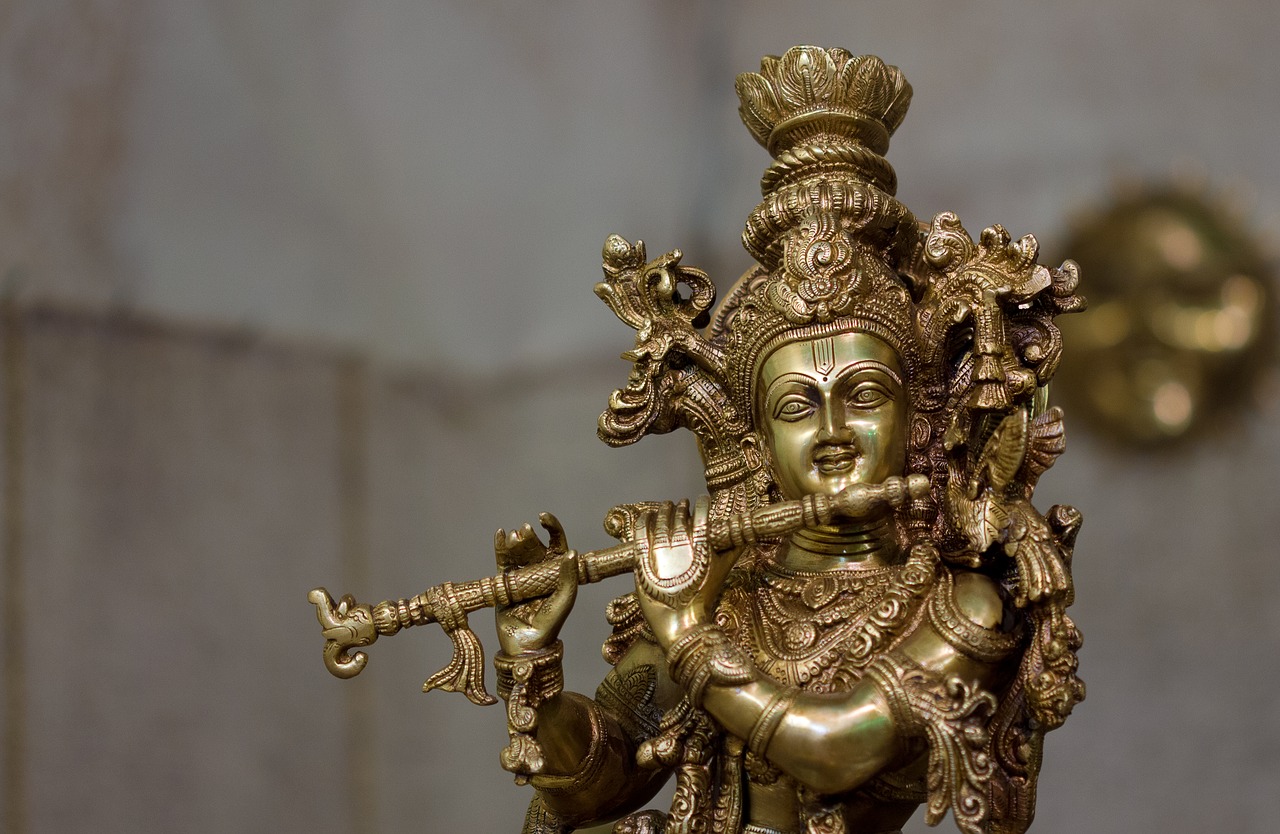
Krishna, together with Rama, is the deity Hindu’s worship the most. But overall, Hindu’s have more of a fascination with Krishna. But why? After all, he is a childlike prankster, a womanizer and a mischievous thief. His actions are not always moral and Godly.
But Krishna’s devotees forgive the God for his miscreants because he means so much more to them. He is a king, a warrior, a guru and advisor with unlimited knowledge. He is the perfect balance of life.
And Krishna is the personification of love.
In Hindu myth, Krishna has everything going for him. He is an inspirational leader, a consummate politician and the assured confidante in battle. He conquers everything he puts his mind to. Even 16, 801 brides. But the number of wives Krishna has does not make him a womanizer or adulterer. The number has special symbolic significance.
When you add the digits in the above number using the ancient form of mathematics known as gematria, you get seven (1 + 6 + 8 + 0 + 1 = 16: 1+6 = 7).
Seven is a feminine number and in ancient alchemy represents emotion. And like everything in the world, emotions have a polarity. The positive on the scale of emotion is love. At the opposite end is fear. Krishna shows us how to love and how to overcome fear.
Given Krishna’s birth was through divine power – the result of an immaculate thought – the adorable prince signifies the connection between the spiritual and the material world. His stories teach the lessons we need to learn to master our emotion. Love, Strength and Wisdom.
As the converted Hindu Stephen-Knapp says on his website:
“One of the reasons why I became a Krishna bhakta is that He is the God of unconditional love, which is something that everyone is looking for, and He also instructed in the Bhagavad-gita that we should stand up and protect Sanatana-dharma for the benefit of others.”
The political influence of Krishna’s rise
Krishna’s popularity began to flourish in the first century AD, around the same time as Jesus. The parallels in the life of Jesus and Krishna are strikingly similar.
In Hindu myth, Krishna is named as the eight avatar of Vishnu, the Supreme God that symbolizes absolute consciousness. Hence in Hindu mythology, Krishna is born from divine inspiration.
Vishnu’s previous avatar, Rama, is still also a popular figure amongst Hindus. In ancient myth, Rama is a God personified as a man and represents moral values. However, in the first century AD, a great political and religious struggle changed the perception of Hindus.
Muslims were impressing themselves upon the sub-continent and threatening people to convert to Islam; by consent or by the sword. Islam triggered ideas of reform as well as their relationship with God. The moral goodness in mankind had been compromised. People began to turn to the wisdom and divine virtue of Krishna.
In the Bhagavad Gita, Krishna says “One who sees everyone in Me and sees Me in everyone, for such a person, I shall never remain hidden and he shall never be far from me.”
These powerful words were enough to convince people to dedicate their worship to Krishna. People wanted a God that stood for love and goodness, not a pantheon of devas that were forever at war.
Krishna v Rama
If there is one Hindu God that can rival Krishna for most popular deity, it’s Rama. Despite the 1st century reforms, Rama survived the power struggle and among Hindus and stands shoulder to shoulder at the altar with Krishna.
Rama was a pious and dutiful God who is described as the ‘perfect human being.’ He is also the reflection of many people you know in your life – thus a reminder to look for the God in man – just as Krishna calls out in the Bhagavad Gita.
Yet Hindus that study the characters of the two Gods, tend to sway towards Krishna as he is a more complete God. Yes, he is a mischievous prankster as a child, but as an adult, he becomes an inspirational thought leader.
This is the God people want to aspire to.
Rama on the other hand was surrounded by idealistic people. Krishna supporters argue Rama was a small minded man. They call into question whether his morals and actions set a good enough benchmark.
A prime example is when Rama shows a degree of jealousy by questioning his wife Sita if she is still ‘pure’ just after he rescues her from captivity. In other words, Rama asks his wife if she slept with the enemy.
But Rama often captures the imagination of children and many unfailingly carry this belief into their adulthood. Krishna is seen as cunning that gives into temptation. And we are taught that temptation is bad for soul development. Rama on the other hand is steadfast and unassailable.
It is quite often during teenage years, that Krishna becomes the hero for young Hindus. He has the ability to conquer anything he puts his mind to, and that nature within man is more appealing to ambitious adolescents. They need confidence, faith and love and this is what Krishna teaches.
This is the reason why for many Hindus, Krishna becomes the realization as the consummate God in man. He does what is right and what is real, even if he has to bend the rules.
But let’s remind ourselves that both Krishna and Rama are avatars of Vishnu. And although Vishnu still remains popular among Hindus, he is not as commonly worshipped as the later deities. Probably because he is older.
But essentially, the later Gods are reincarnations of earlier Gods that inspired ancient Ayurvedic writers to create more religious stories in association with the times they lived in. You can trace every God that ever surfaced in ancient myth back to an earlier source of writing.
Yes, Krishna has a dark side, but don’t we all. It is the ability to overcome the dark passenger that resides within that is important. Throughout his life, Krishna reflects the stages of life we go through, but in the end, Krishna masters his emotions and becomes unconditional love. And this is what we must also strive for.