















Relationships are the foundations of many festivals in India. One such festive occasion is the Rakshabandhan. Rakshabandhan acknowledges the bond of love and protection between a brother and a sister. On this auspicious occasion, siblings wish for each others’ joy and pray for each others’ good health. Rakshabandhan is celebrated on the full moon day of the lunar month Sharavana.
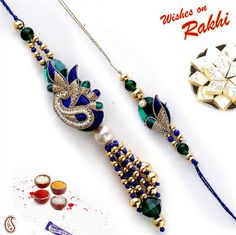
On this occasion, sisters apply tilak on the forehead of their brothers and tie a sacred thread, Rakhi, on their brothers’ wrists. The sister prays for the welfare of the brother and his protection from evil. The brother promises to always protect and take care of his sister. In the recent times, the festival has shifted its focus from just a brother and a sister; the Rakhi can also be tied by, let us say, a disciple to their Guru. Also important to note is, the celebration is not reserved for blood relatives only, as a girl can ‘adopt’ a brother through tying of the silk thread around his wrist.
The ritual has now gone beyond recognizing the warmth and affection between siblings, as Rakhi is now even tied around the wrists of good friends and neighbors to accentuate the need of an amicable social life.
ORIGINS
The origins of this festival are attributed variously to the following fabled events:
1. The fight of Indra with Vritra – Indra, the king of the gods, had lost his kingdom to the demon Vritra. At the orders of guru Brihaspati, Sachi, Indra’s wife tied a thread around the wrist of her husband to secure his victory in the next match. This was a sign of protection against evil. However, later the tradition developed around the brother – sister relationship rather than between spouses.
2. Draupadi and Krishna during the Rajsuya Yagya – Krishna cut his finger while the beheading Shishupal (as punishment for his outrages), and Draupadi, the wife of Pandavas, tore a strip of her sari and tied it on Krishna’s finger to stop the bleeding. She thus said to have tied him in debt as Krishna promised he would repay each and every ‘thread’. True to his word, when Draupadi needed Krishna’s help, he came to her rescue in a later event, and prevented her from being stripped in front of the court.
3. Rani Karnavati and the emperor Humayun: During the medieval period, the Rajputs fought against the Muslim invaders. Rakhi was a spiritual symbol associated with the protection of the sisters. According to the story, a Rakhi was sent by Queen Karnavati, the widow of the then king of Chittor to Emperor Humayun.
The Emperor was really moved by the sweet gesture and he accepted the rakhi and thenceforth considered the Karnavati as his sister.
THE CELEBRATION OF RAKSHABANDHAN IN INDIA
Rakshabandhan is celebrated all over India by people from all walks of life, but different regions in the country celebrate the day differently.
RAKHI PURNIMA
This is how Rakshabandhan is called in the north and the northwest India. The word “Purnima” means a full moon night.
PURNIMA NARIYAL
In western India and parts of Maharashtra, Gujarat, and Goa, this day is known as Nariyal Purnima. On this day, an offering of coconuts (nariyal) is made to the sea as a form of respect to the god Varuna, the god of the sea. Nariyal Purnima is the symbol of the commencement of the fishing period and fishermen, who depend on the sea for a living, make an offering to the god Varuna so they can collect abundant fish in the next fishing season.
AVANI AVITTAM / UPAKARMAN
In parts of southern and eastern India (Kerala, Andhra Pradesh, Tamil Nadu and Orissa), this day is celebrated as the day of Avani Avittam. In Karnataka, it is known as Upakarma by the followers of Yajurveda.
PURNIMA KAJARI
In the central part of India and Madhya Pradesh, Chhattisgarh, Jharkhand, and Bihar, this day is known as Purnima Kajari. It is a very important and blessed day for farmers and women. In the Kajari Navami, there are performances of various rituals by mothers, and they last until the day when the full moon arrives.
This is the most beloved and sweetest of festivals in Hinduism that started generations back and has lived on to this day. It marks the sweet bond that lies between a brother and a sister and the day is marked with happiness and joy in their lives.
Rakshabandhan festival not only symbolizes the bond of love, protection and care, but also transmits an innate message of universal love between siblings. It brings out the spiritual significance of nurturing positive thoughts for each other.