

















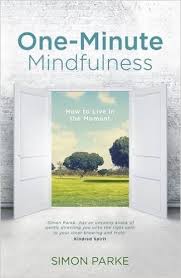
One-Minute Mindfulness by Simon Parke is a collection of short essays and stories that help shift our thinking onto a more mindful path.
Introduction
The book starts with an introduction, which explains what mindfulness is.
1. Awareness of yourself and the world
2. Living in the present
3. Acceptance of your situation (which strangely is the catalyst for good change).
The book does not give a detailed explanation of how to achieve mindfulness. However, there are a few simple exercises scattered through its pages. What the book does offer are stories that help us shift our thinking, much like Zen koans. The author says, ‘I offer mindful stories and thoughts for when you sense the need for a psychological or emotional shift in your life.’
The Chapters
The book is divided into eight chapters each with a theme that covers an aspect of mindfulness.
1. Becoming Simple
2. Becoming Aware
3. Becoming Present
4. Becoming Trust
5. Becoming Impermanent
6. Becoming Nothing
7. Becoming One
8. Becoming Behaviour
The stories are short, less than a page each and so easily read in under a minute. However, it is worth reading the stories more than once to get to their underlying truth. Some of the stories didn’t make much sense to me on first reading, but the more I thought about them, the more I understood something new about mindfulness. It was the most difficult stories that actually caused the biggest shift. Not all the stories are difficult to understand, many are simple stories that nonetheless have a big impact.
Mindfulness and Breathing
The first story in the book, In search of the unborn, I found quite a challenge to get my head round which nearly put me off the book. But I did find an internal shift happened after I read it a few times and I was glad that I continued with the book. Later in the book, the author offers this explanation of mindfulness, ‘Mindfulness is an invitation to fresh experience and virgin knowing in which present thoughts and emotions are allowed to speak without judgment or rejection.’ I found these words helped to calm my busy ‘monkey mind.’ He compares our breathing to a lighthouse which can ‘guide you to safe harbor through the crashing water and battering winds.’
Becoming Present
In the chapter, Becoming Present the author explains the importance of noticing the breath and how this can be a great way to become more present. He also argues that anxiety can be a desire to be distracted from the present out of fear of what it might hold. The author also explains how ‘if we take our emotional state for granted as if it is inevitable and outside our jurisdiction, it can acquire the power of a rampaging elephant, dangerous and out of control.’
There are some beautiful, mindful passages in the book which really did help me to think about my life differently. One such passage is ‘If rush and impatience is your manner of spiritual travel, don’t expect to arrive anywhere beautiful’. This sentence made me look differently at how I was trying to become mindful as if it was a job to tick off my to-do list rather than a state to embrace.
Dealing with Anxiety
There are several sections of this book that address anxiety. These helped me to look at my anxiety in a different way. Particularly helpful in this was the idea that ‘beyond anxiety is not the absence of anxiety, but an increasing capacity to accept it as a visitor.’
The book uses examples from different traditions and religions to help us understand our suffering. There are stories from the Bible and also many examples of Buddhist philosophy such as ‘the fruit of mindfulness is awakening, a state in which greed, hatred, and delusion are removed.’
Many sections of this book are very comforting. I liked the idea that ‘the opposite of depression is not happiness, it is vitality.’ I also found comfort in the idea that ‘the soil of your existence needs it all, the difficult and the easy; the awkward and the presentable.’
The book also warns us about some traps of spirituality. For example, ‘ The ego thrives when we strive. If we desperately desire this or passionately desire that (even spirituality) our ego will be in seventh heaven’.
How to use One-Minute Mindfulness
This is not a book to be read in one sitting. Rather it is one to either read a page a day to set the tone for your experience of life, or to dip into when you feel the need. The book is a calming, comforting resource. It really can shift your thinking away from busyness and stress and help you to be more present and aware.
Overall Impressions of One-Minute Mindfulness
I think this book has a lot to offer anyone who is looking for a more mindful way of living. It is easy to use and, though the concepts are simple and mostly easy to understand, they are powerful and provoking.
I would recommend this path to anyone who would like a simple way to introduce more mindfulness in his or her life.
I would rate it 8/10 as a mindfulness resource.