
Home › Events › The Festival That Prays to the Setting Sun
EventsThe Festival That Prays to the Setting Sun
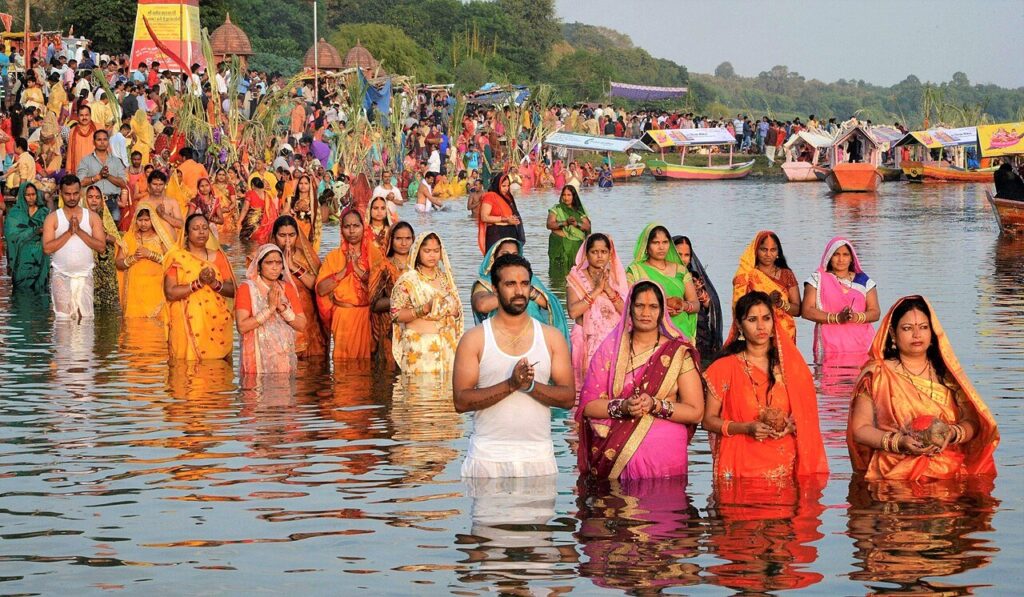
Most prayers face the sunrise. Chhath does something braver. On its main evening, people walk into a river, or a lake, or in some American suburbs a carefully filled backyard pool, and they offer their prayer to a sun that is going down.
Then they come back before dawn and do it again for the sunrise.
Chhath belongs most of all to Bihar, Jharkhand, eastern Uttar Pradesh and the Terai of Nepal, and to everyone who has moved away from there and refuses to let it go. It honors Surya, the sun, and Chhathi Maiya, a mother goddess who is asked to protect children. If you read our story about Saranya, the wife who left the sun, this is the same sun, seen from the other side: not a difficult husband, but the one who keeps every living thing going.
Chhath Puja 2026 dates
Most calendars give these dates in India. Your local temple or community group will confirm the exact days and sunset times for your city.
- Friday, November 13: Nahay Khay. A ritual bath and one simple meal, often rice, chana dal and bottle gourd, cooked with care and no onion or garlic.
- Saturday, November 14: Kharna. A fast all day, broken at evening with kheer made with jaggery, and roti. After this, many devotees begin a fast without even water that lasts about a day and a half.
- Sunday, November 15: Sandhya Arghya. The evening offering to the setting sun.
- Monday, November 16: Usha Arghya. The morning offering to the rising sun, and then the fast is broken.
What you’ll see at the water
Women, and many men, standing waist-deep in the water as the light goes orange. In their hands, a soop, a flat bamboo basket, piled with fruit, sugarcane, coconut, and thekua, a hard, sweet, deep-fried cookie of wheat flour and jaggery that every family insists theirs does best. Songs that have been sung on riverbanks for generations, often in Bhojpuri or Maithili, and an older relative correcting everyone’s words.
Nobody is in a hurry. Waiting for the sun is the whole point.
Why the setting sun?
There isn’t one official answer, and people will give you several. One that I find moving is the simplest: you thank the sun for the day it just gave you before you ask for another one. Gratitude first, request second.
It also asks something of the body. Standing in cold water in November, after a fast, is not comfortable, and that discomfort is part of the offering. The care that goes into the cooking matters too. Many families make the prasad in a cleaned kitchen, on a separate stove, with new utensils kept just for this.
Chhath in America
In the Gulf Coast heat or a Minnesota November, the river is the hard part. Families look for a lake or a park pond and sometimes get a permit for it, community groups organize a shared ghat, and some families bring the river home: a clean tub or pool on the patio, a few lamps, and the whole street invited.
If you’re new to it and someone invites you, go. Bring nothing but warm clothes and patience. Stand where you’re shown, keep your voice low while people are offering arghya, and accept the thekua when it comes around. You’ll be eating thekua for a week anyway, because there is always more.
If you’re keeping the fast
The Chhath fast is serious, and the water fast especially. If you’re pregnant, diabetic, older, or on medication, talk with your doctor first. Many families have the healthiest member keep the full fast while others help in other ways, and that is part of the tradition too: nobody does Chhath alone.
And if your aunt says your thekua is “almost right,” take it as the compliment it is. That’s the highest score anyone has ever been given.
Find more videos on our YouTube channel: Subscribe to Antaryami
Find more videos on our YouTube channel
Subscribe to Antaryami