
Home › Mythology › Why Vishnu Sleeps for Four Months
MythologyWhy Vishnu Sleeps for Four Months
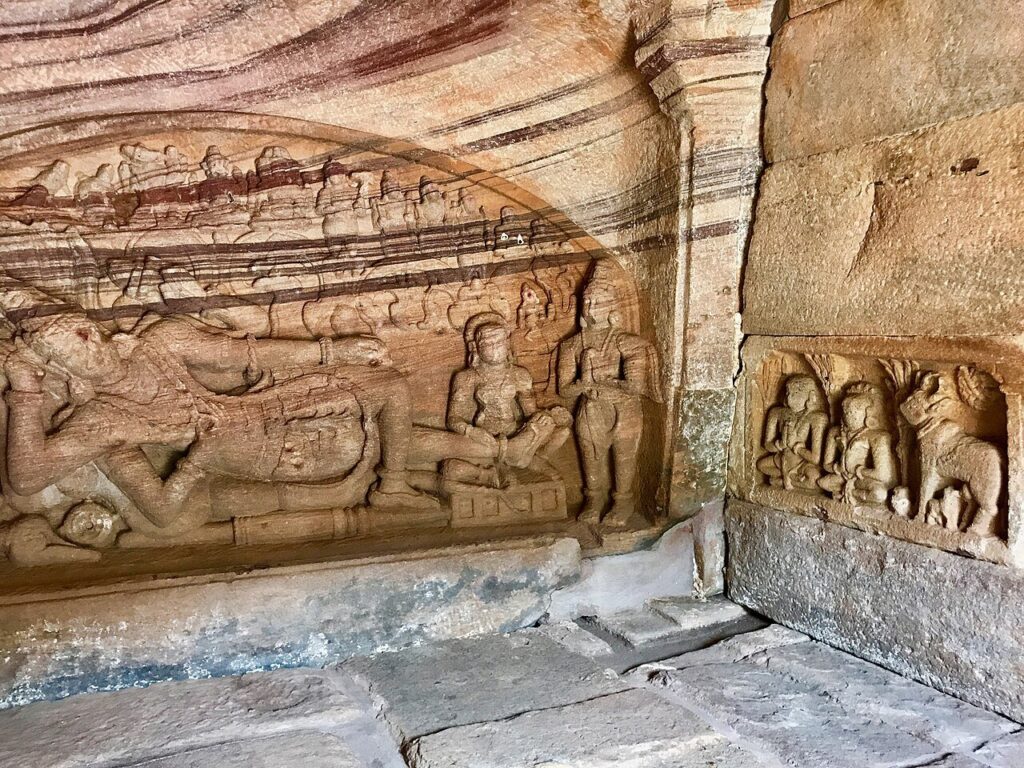
There’s a painting you have probably seen. A dark-skinned god lies on an enormous coiled serpent, floating on an endless ocean. His eyes are half closed. Lakshmi sits at his feet. A lotus rises from his navel, and on the lotus sits Brahma, about to make a world.
That is Vishnu asleep. And according to a widely kept tradition, he is sleeping right now.
The four months
Every year, on an Ekadashi in the summer month of Ashadha, Vishnu is said to lie down on Shesha, the serpent of endless coils, in the ocean of milk. The day is called Devshayani Ekadashi: the Ekadashi when God lies down. Four months later, on the Ekadashi of Kartik, he wakes. That day is Prabodhini Ekadashi, or Dev Uthani Ekadashi: the Ekadashi when God gets up.
In 2026 that waking day falls on Friday, November 20.
The months in between are Chaturmas, the “four months.” Many families avoid weddings, housewarmings and other big new beginnings during this time, and some take on a small discipline, giving up a food, or reading a scripture daily. Monks traditionally stop wandering and stay in one place for the rainy season.
Why would a god need to sleep?
This is the good question, and the tradition gives more than one answer.
The sleep isn’t really sleep. The texts call it yoga nidra, yogic sleep: rest on the outside, total awareness within. Vishnu isn’t tired. He’s withdrawn, the way the world itself seems to withdraw in the heavy monsoon months, when roads wash out and travel stops.
A promise to a king. One popular story ties the sleep to Bali, the generous demon king. Vishnu, in his dwarf avatar Vamana, asked Bali for three steps of land, then grew to cosmic size and covered the earth and heavens in two strides. Bali, a man of his word, offered his own head for the third. Moved by that, Vishnu sent him to rule the underworld and promised to stay with him for part of each year. In some tellings, those are the four months.
A rhythm for us. A more down-to-earth reading: the monsoon in India made weddings, journeys and building difficult anyway. The calendar simply gave a sacred shape to a season when everyone should slow down.
You don’t have to choose one answer. Hindu stories are generous like that.
Waking him up
On Prabodhini Ekadashi, many families fast or eat simply, and in the evening they sing to wake Vishnu. In parts of North India, people draw his footprints in rice flour and set out sugarcane, water chestnuts and new-season fruits. Bells ring. “Utho, Dev!” Get up, Lord.
The next day often brings Tulsi Vivah, the wedding of the tulsi plant to Vishnu, and with it the start of the wedding season. In 2026 that’s November 21. Banquet halls across New Jersey and Texas, consider yourselves warned.
The idea underneath
What strikes me about this story is that it gives even God a season of rest, and then builds a celebration around waking up. Rest isn’t treated as laziness. It’s treated as part of how the world is held together.
So if you’ve been running hard all year, take the hint. The preserver of the universe takes four months off. You can probably manage a Sunday afternoon.
Find more videos on our YouTube channel: Subscribe to Antaryami
Find more videos on our YouTube channel
Subscribe to Antaryami