
Home › Yoga › Five Minutes of Yoga for a Body That Woke Up Stiff
YogaFive Minutes of Yoga for a Body That Woke Up Stiff
It’s 6:40 on a dark December morning. You swing your legs out of bed and your back makes a sound like an old wooden staircase. Your neck turns about halfway. The floor is cold, the kitchen is far away, and the idea of a full yoga class feels like a joke.
You don’t need a class. You need five minutes and a patch of floor.
This routine is built for exactly that morning. No standing on one leg, no deep backbends, nothing that asks a cold body to do something dramatic. Just slow movement that tells your joints the day has started.
Before you start
- Put on socks or stand on a rug or mat so you don’t slip.
- Move slowly. A cold body is a stiff body, and stiff muscles don’t like surprises.
- Breathe through your nose if you can, and never hold your breath.
- Stay in a comfortable range. A gentle stretch is the goal. Pain, numbness or tingling means back off.
If you have back or joint problems, high blood pressure, are pregnant, or are recovering from an injury or surgery, check with your doctor before starting a new routine.
Minute 1: Lying-down wake-up
Stay in bed or lie on the floor on your back. Reach your arms overhead and point your toes, a long full-body stretch, like a cat that just woke up. Hold for a breath, then relax. Do it three times.
Then hug your knees to your chest and rock gently side to side. Many people find this a kind way to greet the lower back.
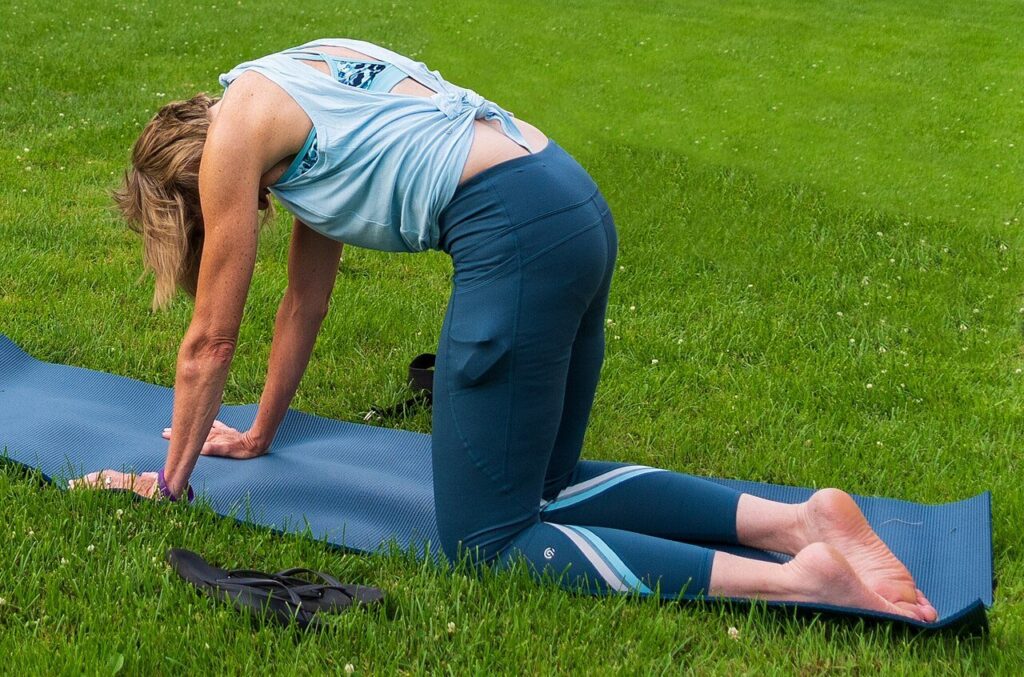
Minute 2: Cat and cow (Mārjaryāsana and Bitilāsana)
Come onto your hands and knees, hands under shoulders, knees under hips. Pad your knees with a folded blanket if the floor is hard.
As you breathe in, let your belly drop slowly and lift your gaze a little. As you breathe out, round your back up toward the ceiling and let your head hang. Move with your breath, about six to eight rounds.
Safety cue: keep the movement small at first. If your wrists complain, come down onto your forearms.
Minute 3: Child’s pose (Bālāsana) with side reach
From hands and knees, sit your hips back toward your heels and rest your forehead on the floor or a pillow. Arms stretch forward. Take three slow breaths.
Then walk both hands over to the right and feel the stretch along the left side of your body. Three breaths. Then walk them to the left.
Safety cue: if your knees don’t like deep bending, put a pillow between your hips and heels. If you’re pregnant, widen the knees and keep it gentle.
Minute 4: Seated neck and shoulder release
Sit cross-legged on the floor, or on the edge of the bed with feet flat. Roll your shoulders slowly backward five times, then forward five times.
Let your right ear drop toward your right shoulder. Breathe there for three breaths. Switch sides. Then slowly look over one shoulder, back to center, and over the other.
Safety cue: no fast neck circles. Keep every movement slow, and stop if you feel dizziness or sharp pain.
Minute 5: Standing reach and three breaths
Stand with feet hip-width apart. Breathe in and sweep your arms up overhead. Breathe out and lower them. Do this five times, slowly.
Then stand still, hands at your sides or palms together at your chest, and take three full breaths. Notice your feet on the floor. Notice that your back, which a few minutes ago felt like a folded lawn chair, now feels a little more like a back.
Why the morning matters
Yoga tradition has long favored the early hours for practice, and Ayurveda describes winter mornings as a time when the body tends to feel heavier and slower. You don’t need to buy into every detail of that to notice something simple: a few minutes of movement before the phone and the coffee changes the tone of the day.
Five minutes isn’t much. That’s the point. It’s short enough that you’ll actually do it tomorrow.
Keep it easy
Some mornings you’ll do the whole thing. Some mornings you’ll only manage the stretch in bed. Both count. Do this a few days in a row and you may find the floor feels a little less cold, or at least a little less far away.
And if the family dog decides to join you for downward dog, let it. It has been practicing that pose its whole life, and it will happily show you how it’s done.
Find more videos on our YouTube channel: Subscribe to Antaryami
Find more videos on our YouTube channel
Subscribe to Antaryami