
Home › Mythology › The Friend Who Brought Krishna a Handful of Poha
MythologyThe Friend Who Brought Krishna a Handful of Poha
Thanksgiving tables in America groan under food. Turkey, stuffing, three kinds of pie, the green bean casserole nobody admits to liking, and somewhere in a Hindu home, a big bowl of poha that an aunt made “just in case.”
So today, of all days, is a good day to tell a story about the smallest gift in Hindu mythology. A handful of beaten rice, tied in a worn piece of cloth, carried by a man who was too embarrassed to hand it over.
Two boys at school
Long before Krishna was a king in Dwarka, he was a student. He and his brother Balarama studied at the ashram of the teacher Sandipani. One of their classmates was a gentle, poor brahmin boy. Most families know him as Sudama. In Kerala and much of South India he’s called Kuchela, a name that points to his ragged clothes.
The main source is the Bhagavata Purana, in the tenth book, chapters 80 and 81. Interestingly, the Bhagavata itself mostly just calls him “a brahmin friend of Krishna.” The name Sudama is how later tellings, songs and family storytellers came to know him.
The boys grew up and went separate ways. Krishna became a king. His friend stayed poor, devoted, and content, living on whatever came his way.
The gift he was ashamed of
Years later, Sudama’s family had almost nothing to eat. His wife, knowing whom her husband had gone to school with, gently asked him to visit Krishna. Not to beg, just to go. Surely an old friend would help.
Sudama agreed, partly because he simply wanted to see Krishna again. But you don’t visit a friend empty-handed. So his wife borrowed a few handfuls of flattened rice, poha, from the neighbors. In the Bhagavata it’s called pṛthuka. She tied it into a corner of his old cloth, and he set off on foot.
When he reached Dwarka and saw the golden palaces, he lost his nerve. How could he give a king a fistful of beaten rice?
The welcome
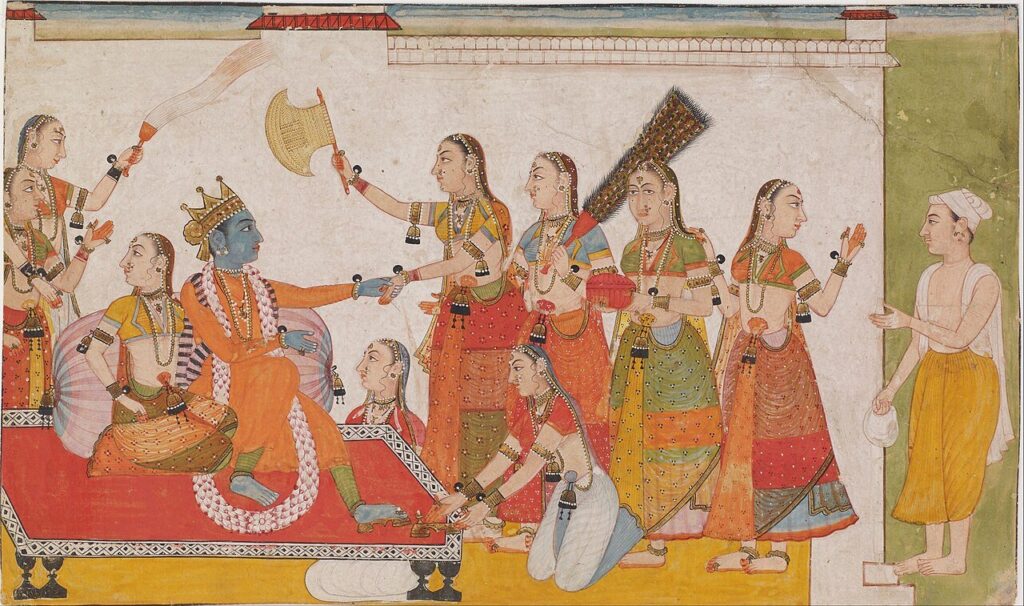
Krishna saw him from a distance, got up from the couch where he was sitting with Rukmini, ran to him and embraced him. He sat Sudama on his own seat, washed his feet, and the two old classmates talked for hours about their teacher and their school days.
Sudama kept the little bundle hidden. Krishna, who knows what is hidden, teased him: “What did you bring me?” And when Sudama still hesitated, Krishna pulled the cloth away himself, found the poha, and ate a handful with total delight, as if it were the best food in the world.
In the Bhagavata, Krishna reaches for a second handful and Rukmini gently catches his hand, because one handful offered with that much love was already enough to fill the house with blessings for a lifetime. Some tellings play this for laughs, the queen protecting the palace budget.
He never asked
Here’s the part that surprises kids. Sudama went home without asking for anything. Not a coin. He walked back thinking about his friend’s kindness and feeling a little relieved that he hadn’t embarrassed himself by asking.
When he reached his village, his hut was gone. In its place stood a fine house, and his wife came out to meet him dressed in good clothes. Krishna had given everything without being asked, and without saying a word about it.
What the story is really about
The poha is the heart of it. In the Bhagavad Gita, chapter 9, verse 26, Krishna says:
patraṁ puṣpaṁ phalaṁ toyaṁ yo me bhaktyā prayacchati
“Whoever offers me a leaf, a flower, a fruit or water with devotion, I accept it.” In the Bhagavata’s telling of this very story, Krishna says nearly the same words to Sudama. The size of the gift doesn’t matter. The love in it does.
There’s a second lesson for a day like Thanksgiving. Sudama’s gratitude didn’t depend on getting something. He was grateful for the friendship itself. The house came later, almost as an afterthought.
In Kerala, the Guruvayur temple keeps a day called Kuchela Dinam in the Malayalam month of Dhanu, around December, when devotees offer aval, beaten rice, in his memory.
Telling it at the table
Before the meal, you might give each child a small spoonful of poha and tell them this story. Ask: “Who is someone you’re grateful for, even if they never gave you anything big?” Kids usually have great answers. Grandparents usually have better ones.
And if anyone at the table reaches for a fourth helping of pie, you now have a scriptural precedent for stopping them. Just say you’re doing a Rukmini.
Find more videos on our YouTube channel: Subscribe to Antaryami
Find more videos on our YouTube channel
Subscribe to Antaryami